What counts as a restructuring?
A programme planned and controlled by management that materially changes either the scope of the business or the way it is run. Not a cost-cutting exercise, not a reorganisation of reporting lines, and not a redundancy round on its own.
A restructuring is a programme that is planned and controlled by management and materially changes either the scope of a business undertaken by an entity or the manner in which that business is conducted.
The standard gives its own examples: sale or termination of a line of business; the closure of business locations in a country or region or the relocation of business activities from one country or region to another; changes in management structure, for example eliminating a layer of management; and fundamental reorganisations that have a material effect on the nature and focus of the entity's operations.
Example 1: which of these is a restructuring?
| Programme | Restructuring? |
|---|---|
| Closing two of five manufacturing sites and moving output abroad | Yes. Closure of locations and relocation of activities (para 70) |
| Removing a regional management layer across the group | Yes. Change in management structure (para 70) |
| A 5% headcount reduction spread across all functions with no structural change | No. Termination benefits under IAS 19, not a restructuring |
| Rebranding and a new marketing strategy | No. No material change to scope or manner of operations |
Real company: Nestlé, 2024
Nestlé reported restructuring and net other trading items of CHF 1.1 billion for 2024, down from CHF 1.5 billion in 2023, with the reduction attributed mainly to lower restructuring costs. Free cash flow of CHF 10.7 billion was helped in part by lower cash restructuring costs.
Two things are worth noticing. First, restructuring is reported as a recurring line in a business of this size, not a one-off event. Second, the charge and the cash are disclosed separately, which is the practical reason the para 84 reconciliation matters: a falling charge and a falling cash outflow are not the same statement.
Nestlé S.A., Full Year Results 2024. Figures as reported.Local FAQs
Are redundancy costs always a restructuring provision? No. Termination benefits are measured under IAS 19. IAS 37 governs whether a restructuring obligation exists and what other direct costs can be included.
Does the programme have to be group-wide? No. It has to materially change the scope or the manner of a business, which can be a single division or location.
Potential risks
Ordinary cost reduction labelled restructuring. It attracts an exceptional-item presentation the substance does not support.
IAS 19 bypassed. Termination benefits have their own measurement rules and their own recognition timing.
When does the obligation arise?
Only when you have a detailed formal plan covering five specific things, and you have told the people affected or started doing it. A board decision on its own is not enough, however firm.
A constructive obligation to restructure arises only when an entity has a detailed formal plan for the restructuring identifying at least the business or part of a business concerned, the principal locations affected, the location, function and approximate number of employees who will be compensated for terminating their services, the expenditures that will be undertaken, and when the plan will be implemented; and has raised a valid expectation in those affected that it will carry out the restructuring by starting to implement that plan or announcing its main features to those affected by it.
A management or board decision to restructure taken before the end of the reporting period does not give rise to a constructive obligation at the end of the reporting period unless the entity has, before the end of the reporting period, started to implement the restructuring plan, or announced the main features of the restructuring plan to those affected by it in a sufficiently specific manner to raise a valid expectation in them that the entity will carry out the restructuring.
Example 2: five weeks, two reporting periods
Board approves a plant closure on 15 December. Employees and their representatives are told on 20 January. Year end is 31 December.
| Date | Position | Treatment |
|---|---|---|
| 31 December | Detailed plan exists, nothing announced or started | No provision. Disclose as a non-adjusting event under IAS 10 if material |
| 20 January | Announcement made | Provision in the following period, qualifying direct costs only |
Announce on 20 December instead and the charge falls in the earlier year. A communication date moves a material charge between two sets of accounts.
Real company: Unilever, 2024
Unilever incurred restructuring costs of €248m in the first half of 2024, up from €184m in the same period of 2023, and guided to full year restructuring costs of around 1.2% of group turnover, with the step up in the second half driven by the cost of implementing its productivity programme.
That second half weighting is the timing question in para 72 made visible. A programme can be announced, and the market can be told what it will cost, well before the specific communications that create a constructive obligation in each affected country. Guidance about future cost is not the same as a present obligation, and a preparer who provides on the announcement date alone will usually be early.
Unilever PLC, Q4 and Full Year 2024 announcement and half year results 2024. Figures as reported.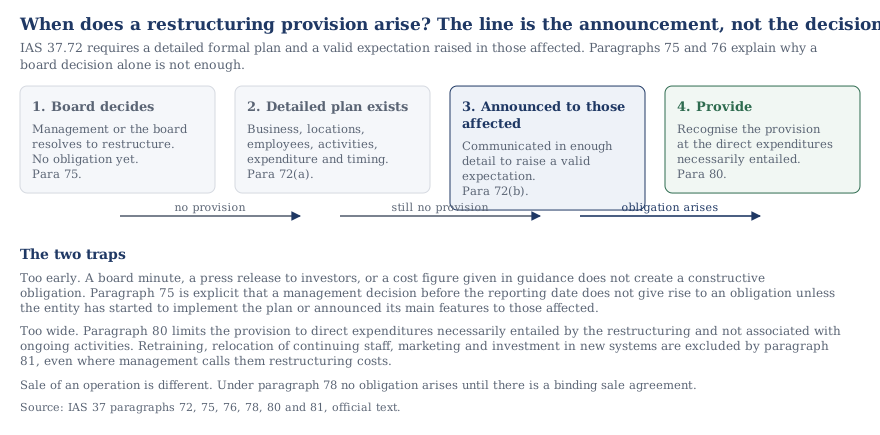
Real company: Bayer, 2024: restructuring recognised in tranches, not in one line
Bayer reported EUR 41 million of restructuring charges in the third quarter of 2024, against EUR 8 million in the same quarter of 2023.
The size relative to the group is the point. Charges of this scale, quarter after quarter, are what recognition in tranches looks like: individual programmes crossing the para 72 threshold as each one is communicated to the people affected, rather than one provision landing on the day a strategy is announced.
If a group's restructuring charge instead arrives as a single large number in one period, that is a question to ask rather than a fact to accept. Either the whole programme genuinely became obligating at once, or something was provided early.
Bayer AG, Quarterly Statement as of September 30, 2024. Figures as reported.Local FAQs
Is a leak an announcement? Para 75 requires the main features communicated in a sufficiently specific manner to raise a valid expectation. A leak may in substance do that; a rumour does not.
Who counts as "those affected"? Employees and their representatives usually, and it can include customers or suppliers where the plan affects them. A market announcement of a specific plan can also raise a valid expectation.
Potential risks
A provision on a board minute alone. The single most common error in this area, and para 75 addresses it directly.
Cut-off not evidenced. The file needs the dated announcement or evidence of implementation, and it must pre-date the reporting date.
Which costs can go in the provision?
Only expenditure that is both necessarily entailed by the restructuring and not associated with the ongoing activities of the entity. In practice that is termination benefits for staff leaving and exit costs directly caused by the programme.
A restructuring provision shall include only the direct expenditures arising from the restructuring, which are those that are both necessarily entailed by the restructuring and not associated with the ongoing activities of the entity.
Example 3: the filter applied
| Cost | In or out | Why |
|---|---|---|
| Redundancy payments to staff being released | In | Necessarily entailed, not associated with ongoing activities. Measure under IAS 19 |
| Penalty to terminate a lease on a closed site | In | Caused by the restructuring |
| Professional fees on the closure itself | In | Necessarily entailed |
| Retraining staff who are staying | Out | Relates to ongoing activities (para 81) |
| New IT system to support the reorganised business | Out | Investment in the future business (para 81) |
| Operating losses at the plant until it closes | Out | Future operating losses (para 82) |
Where firms differ: how much of a restructuring actually reaches the provision
Paragraph 80 gives you a test, not a list. A cost qualifies if it is both necessarily entailed by the restructuring and not associated with ongoing activities. Paragraph 81 then rules out four items by name. Everything else is judgement, and the standard offers no help with it.
KPMG puts the underlying gap plainly: IAS 37 provides no specific guidance on which costs to include in measuring a provision, so approaches vary with the nature of the provision and the entity's own accounting policy. On a restructuring that shows up in the same three arguments every time. Are the fees of the adviser who ran the closure programme necessarily entailed, or part of running the business? Does the retained HR team's time on the redundancy process go in? Where does the cost of a site left empty for six months before disposal sit, given paragraph 82 excludes operating losses to the closure date?
Different firms land differently on all three, and the answer moves the provision materially. The IASB's Exposure Draft ED/2024/8 would replace the current patchwork with a single all-direct-costs basis for every provision, which on most restructurings would widen what qualifies rather than narrow it.
My view: the test in paragraph 80 has two limbs and most disputes are lost on the second one, not the first. Necessarily entailed is easy to argue. Not associated with ongoing activities is where a cost usually fails, because the business carries on and the cost carries on with it. Apply the second limb first and the provision gets smaller and much easier to defend.
KPMG IFRG Limited, Provisions: major accounting changes on the horizon, 2024. IASB Exposure Draft ED/2024/8 Provisions: Targeted Improvements, November 2024. IAS 37 paragraphs 80, 81 and 82.Local FAQs
Are relocation costs for the business itself included? Moving plant and equipment to another site is investment in ongoing activities, so no. Relocating continuing staff is expressly excluded by para 81.
What about consultancy on the strategy that led to the decision? Incurred before the obligation arose and associated with running the business. Expensed as incurred.
Potential risks
A padded provision. Recompute stripping out para 81 to 83 items. Where the number falls materially, the original was not a restructuring provision.
IAS 19 measurement skipped on termination benefits. They are in the provision but measured under a different standard.
What must stay out?
Retraining and relocating continuing staff, marketing, investment in new systems and networks, future operating losses to the closure date, and gains on assets you expect to sell.
A restructuring provision does not include such costs as retraining or relocating continuing staff; marketing; or investment in new systems and distribution networks. These expenditures relate to the future conduct of the business and are not liabilities for restructuring at the end of the reporting period.
Identifiable future operating losses up to the date of a restructuring are not included in a provision, unless they relate to an onerous contract. Gains on the expected disposal of assets are not taken into account in measuring a restructuring provision, even if the sale of assets is envisaged as part of the restructuring.
Why does the paragraph 81 exclusion list feel familiar?
Read that para 81 list again: retraining, relocating continuing staff, marketing, new systems. Every one is a cost of operating in the future, and every one is avoidable by future action. That is IAS 37.19 applied to restructuring, not a separate list to memorise. Once you see it, you can work out what qualifies without checking para 81, because the question is always the same: does this cost arise from the past decision, or from continuing to run the business?
Example 4: the provision recomputed
Management proposes a restructuring provision of 3.8m.
| Component | Proposed | Allowed | Reason |
|---|---|---|---|
| Redundancy payments | 1,800,000 | 1,800,000 | Para 80 |
| Lease exit penalties on closed sites | 600,000 | 600,000 | Para 80 |
| Retraining continuing staff | 400,000 | - | Para 81 |
| New ERP module for the reorganised structure | 900,000 | - | Para 81 |
| Operating losses to closure | 300,000 | - | Para 82 |
| Expected gain on selling the site, netted off | (200,000) | - | Para 83, cannot be netted |
| Total | 3,800,000 | 2,400,000 |
A 1.4m difference, and the disposal gain netting also understated both the provision and the future gain.
Local FAQs
Can operating losses go in if the contract is onerous? Para 82 makes that the exception. An onerous contract is provided for under paras 66 to 69 in its own right.
Where does the disposal gain go? Recognised on disposal under the standard governing the asset, usually IAS 16. Never netted against the provision (para 83).
Potential risks
Disposal gains netted. Understates the provision and pulls a gain into the wrong period.
"Non-recurring" treated as a test. It is not. The test is whether the cost is necessarily entailed and unrelated to ongoing activities.
How does US GAAP differ?
Less than most comparisons suggest. Both frameworks turn on communication rather than the internal decision. The difference is that US GAAP recognises each cost when its own criteria are met, so the charge often lands later and in stages.
IAS 37.72 requires a detailed formal plan and a valid expectation raised in those affected. ASC 420 Exit or Disposal Cost Obligations removed the old commit-to-a-plan trigger in 2002, so an entity can no longer provide simply because it has decided. For one-time termination benefits, ASC 420-10-25-4 then requires four things: management with the authority to approve the action commits to a plan, the affected employees are identified, the benefit terms are specified, and the plan is communicated to those employees.
Read those two sentences together, because they pull in opposite directions and both are true. US GAAP scrapped the old trigger that let a plan commitment alone create the liability, then rebuilt a narrower one inside the termination-benefit criteria. So a management commitment is a necessary condition under ASC 420 in a way it is not under IAS 37, while communication is required by both. KPMG makes a further point that catches people out: under US GAAP, one-time termination benefits cannot be recognised any earlier just because they form part of a restructuring, whereas IAS 37 treats the restructuring itself as the obligating event. The residual difference is that ASC 420 recognises other exit costs, such as contract termination, only when the liability is actually incurred, so the charge lands later and in stages.
Example 5: same closure, different phasing
| IAS 37 | ASC 420 | |
|---|---|---|
| Trigger | Detailed plan plus announcement or implementation | Plan approved, employees identified, terms specified, communicated |
| Termination benefits | Recognised on announcement | Recognised on communication, or over the service period if future service is required |
| Other exit costs | In the provision at announcement if directly entailed | Recognised when incurred |
| Effect | Charge grouped at announcement | Charge often spread across later periods |
Local FAQs
Is US GAAP stricter? Not on the trigger. It is more granular, which usually delays part of the charge rather than preventing it.
Do both exclude retraining and relocation? Both keep costs of the ongoing business out, by different routes. IAS 37.81 lists them; ASC 420 gets there by requiring each cost to meet its own recognition criteria.
Potential risks
The pre-2002 US rule quoted. "Commit to a plan" was removed by SFAS 146, now ASC 420. Anything relying on it is superseded.
One conclusion used for both frameworks. The phasing genuinely differs, so a dual reporter needs two analyses.
What do people get wrong most often?
- A provision on a board decision alone (para 75).
- Retraining, relocation, marketing or new systems included (para 81).
- Future operating losses to closure included (para 82).
- Expected disposal gains netted off (para 83).
- Termination benefits not measured under IAS 19.
- Announcement date not evidenced against the reporting date.
- The superseded US "commit to a plan" trigger quoted.
What should you remember from this page?
- A restructuring materially changes the scope or manner of a business (para 10, 70).
- The obligation needs a detailed formal plan with five elements and either announcement or implementation (para 72, 75).
- Only directly entailed costs unrelated to ongoing activities go in (para 80).
- Para 81 is para 19 applied to restructuring: everything excluded is a cost of operating in the future.
- US GAAP also turns on communication, but phases other exit costs later.
Frequently asked questions
What counts as a restructuring under IAS 37?
A programme planned and controlled by management that materially changes either the scope of a business or the manner in which it is conducted (IAS 37.10). The standard's examples include sale or termination of a line of business, closure or relocation of locations, changes in management structure, and fundamental reorganisations (IAS 37.70).
Is a board decision enough to recognise a restructuring provision?
No. IAS 37.75 requires the entity to have started implementing the plan, or announced its main features to those affected in a sufficiently specific manner to raise a valid expectation, before the reporting date. A detailed formal plan alone does not create a constructive obligation.
What must the detailed formal plan contain?
At least the business or part concerned, the principal locations affected, the location, function and approximate number of employees who will be compensated for terminating their services, the expenditures to be undertaken, and when the plan will be implemented (IAS 37.72).
Which costs can go in a restructuring provision?
Only direct expenditures that are both necessarily entailed by the restructuring and not associated with the ongoing activities of the entity (IAS 37.80). In practice that is termination benefits for staff being released, measured under IAS 19, and exit costs directly caused by the programme.
What must be excluded?
Retraining or relocating continuing staff, marketing, and investment in new systems and distribution networks (IAS 37.81), future operating losses up to the date of the restructuring unless they relate to an onerous contract (IAS 37.82), and gains on the expected disposal of assets (IAS 37.83).
Why are those particular costs excluded?
Because each is a cost of operating in the future, which is avoidable by future action. That is IAS 37.19 applied to restructuring rather than a separate list. It is why you can work out what qualifies without checking paragraph 81.
How does US GAAP differ on restructuring?
Both frameworks turn on communication rather than the internal decision. ASC 420 removed the commit-to-a-plan trigger in 2002 and requires one-time termination benefits to be communicated to employees (ASC 420-10-25-4). The difference is that ASC 420 recognises other exit costs only when incurred, so the charge is often spread later.
About UQ Consulting
UQ Consulting is an independent technical reference for accounting and audit practitioners, covering IFRS, UK GAAP and US GAAP. Every technical assertion on this site carries a paragraph reference to the standard, and only currently effective guidance is presented as the accounting treatment; superseded standards appear as history or comparison only.
Written and reviewed by Usman Qureshi (ACCA), a Chartered Certified Accountant with a Big 4 audit and advisory background, and founder of UQ Consulting.
Disclaimer. Educational content, not professional advice. Provision recognition and measurement require significant judgement. Paragraph references are to IAS 37 as in force at the date of review. Company figures are drawn from the cited filings. Consult a qualified accountant for your circumstances.