What is a provision under IAS 37, and how is it different from an accrual?
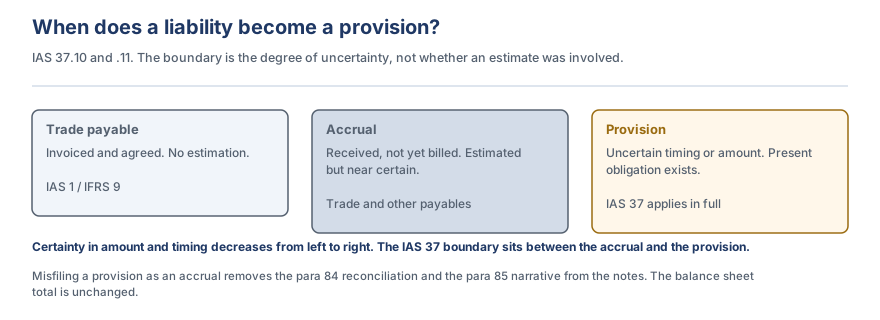
A provision is a liability where you know you owe something but not exactly how much or exactly when. That uncertainty is the whole distinction. An accrual for last month's unbilled electricity is a liability too, but the amount and timing are near-certain, so it sits in trade and other payables and IAS 37 never touches it. The more the estimate is genuinely open, the more likely you are in IAS 37.
The standard defines a provision as a liability of uncertain timing or amount. Read that alongside the definition of a liability itself: a present obligation arising from a past event, whose settlement is expected to result in an outflow of economic resources. So a provision is not a reserve, not a cushion, and not a management intention. It is a liability that already exists, measured with more uncertainty than usual.
The standard draws the line explicitly. Provisions are distinguished from other liabilities such as trade payables and accruals because of that uncertainty. Trade payables are amounts for goods or services received and invoiced or formally agreed. Accruals are amounts for goods or services received but not yet billed, sometimes needing an estimate, but with far less uncertainty than a provision.
Example 1: three liabilities, one of them a provision
A manufacturer's 31 December balance sheet carries three items:
| Item | Amount | Uncertainty | Classification |
|---|---|---|---|
| Invoiced supplier balances | GBP 1,240,000 | None. Invoiced and agreed. | Trade payable |
| December electricity, meter read 6 January | GBP 38,000 | Timing known, amount estimated within a few percent | Accrual, within trade and other payables |
| Warranty claims on units sold in the year | GBP 510,000 | Neither the amount nor the timing is known | Provision, IAS 37 |
Only the third is a provision. The electricity accrual involves an estimate, which is why it gets misfiled, but a meter reading due in six days is not uncertain timing in the IAS 37 sense.
Local FAQs
Is an accrual a provision if you had to estimate it? No. Estimation alone does not make it a provision. The test is the degree of uncertainty in timing or amount, not whether a calculation was involved. An estimated but near-certain amount stays in accruals.
Does it matter which one you call it? Yes, and more than preparers expect. A provision drags in the whole IAS 37 machinery: the para 14 recognition tests, best-estimate measurement, discounting where material, and the para 84 reconciliation disclosure. An accrual carries none of that. Misclassifying a provision as an accrual usually means the disclosure is missing entirely.
Potential risks
The disclosure disappears. This is the practical consequence and it is common. Sweep a warranty or dilapidations balance into "other payables" and the para 84 movement reconciliation, the para 85 timing and uncertainty narrative and the discount unwind line all vanish from the notes. The balance sheet total is unchanged, so nothing looks wrong, which is exactly why it survives review.
The reverse error: calling a cushion a provision. A "general provision" for unspecified future costs fails the definition at the first hurdle, because there is no present obligation from a past event. It is a reserve, and it is not permitted.
When must you recognise a provision? The IAS 37 recognition criteria
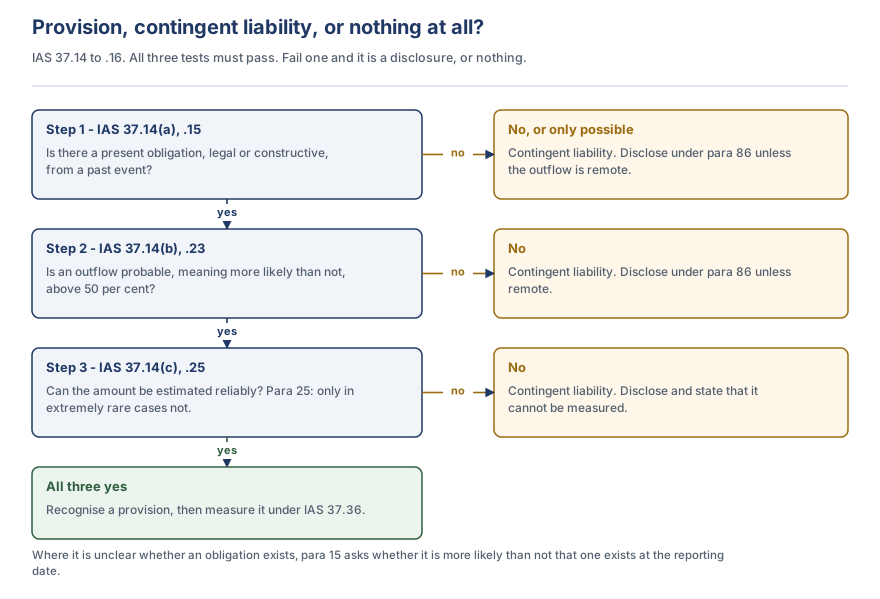
Three tests, all of which have to pass. There is a present obligation from something that has already happened, an outflow is more likely than not, and you can estimate the amount reliably. Fail any one and no provision goes on the balance sheet. The item becomes a contingent liability you disclose, or nothing at all.
A provision is recognised when, and only when: an entity has a present obligation, legal or constructive, as a result of a past event; it is probable that an outflow of resources embodying economic benefits will be required to settle the obligation; and a reliable estimate can be made of the amount of the obligation. The standard adds that if these conditions are not met, no provision shall be recognised.
In rare cases it is not clear whether a present obligation exists. Then the past event is deemed to give rise to a present obligation if, taking account of all available evidence, it is more likely than not that a present obligation exists at the end of the reporting period. Note what this does: it applies the more-likely-than-not test to the existence of the obligation, not only to the outflow.
All available evidence includes, for example, the opinion of experts, and any additional evidence provided by events after the reporting period. A pending lawsuit is the standard case: you weigh counsel's view of whether liability exists at all before you get anywhere near quantifying it.
Example 2: the same lawsuit at three stages
A customer sues for GBP 3m over an alleged product defect.
| Stage | Facts | Para 14 assessment | Accounting |
|---|---|---|---|
| Claim filed, no evidence exchanged | Counsel cannot say whether liability exists | Para 15: existence of a present obligation is not more likely than not | Contingent liability, disclose (para 86) |
| Disclosure complete, counsel advises liability likely, quantum contested between GBP 1m and GBP 3m | Present obligation exists, outflow probable, range estimable | All three tests pass | Recognise a provision |
| Court finds no defect, claim dismissed | No present obligation | Test (a) fails | Reverse the provision (para 59) |
The point is that the accounting follows the evidence, and it moves in both directions. The reversal is not a correction of an error; it is a change in estimate.
Local FAQs
Do the three tests have to be met in order? In practice yes, because the first is the hardest and the other two are pointless without it. If there is no present obligation, there is nothing to measure. Auditors challenge (a) far more often than (b) or (c).
How often does the reliable estimate test actually block recognition? Almost never. Para 25 says that except in extremely rare cases an entity will be able to determine a range of possible outcomes and can therefore make an estimate that is sufficiently reliable. If management is relying on "we cannot estimate it" to avoid a provision, that assertion needs strong evidence.
Does the para 15 more-likely-than-not test apply to the amount too? No. Para 15 addresses whether the obligation exists. Para 23 addresses whether the outflow is probable. Para 36 addresses the amount. They are three separate judgements and conflating them is a common error in memos.
Potential risks
Test (a) treated as a formality. The most common failing is a file that leaps to measuring a number without documenting the past event and the party who now expects settlement. If you cannot name the obligating event and the counterparty, you probably do not have a present obligation.
"Not reliably estimable" used as a shield. Given para 25, non-recognition on measurement grounds is a high bar. An auditor should test whether a range genuinely cannot be constructed, and should expect the answer to be that it can.
Reversal resisted. Test (a) failing later requires the provision to come out (para 59). Management that booked a charge in a bad year has an incentive not to notice. This is the mechanism behind cookie-jar reserving.
What counts as a past event that creates a present obligation?
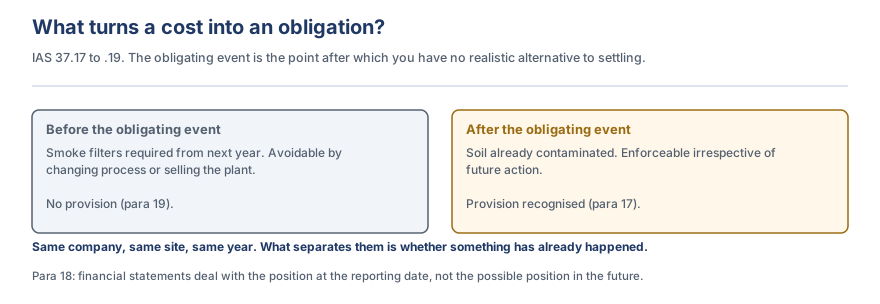
Something must already have happened that leaves you with no realistic alternative to settling. If you could avoid the outflow by changing what you do in future, the obligation has not arisen yet. This is the single most useful idea in the standard, and it is what keeps intentions, plans and budgets off the balance sheet.
A past event that leads to a present obligation is called an obligating event. For an event to be an obligating event, it is necessary that the entity has no realistic alternative to settling the obligation created by the event. That is the case only where the settlement of the obligation can be enforced by law, or where, in the case of a constructive obligation, the event creates valid expectations in other parties that the entity will discharge the obligation.
Financial statements deal with the financial position of an entity at the end of its reporting period and not its possible position in the future. Therefore, no provision is recognised for costs that need to be incurred to operate in the future. The only liabilities recognised are those that exist at the end of the reporting period.
It is only those obligations arising from past events existing independently of an entity's future actions that are recognised as provisions. The standard gives its own examples: penalties or clean-up costs for unlawful environmental damage lead to a provision because settlement is enforceable irrespective of the entity's future actions. By contrast, an entity may intend or need to fit smoke filters in a factory to comply with new legislation. Because it can avoid the future expenditure by its future actions, for instance by changing its method of operation or selling the factory, it has no present obligation for that expenditure and no provision is recognised.
Example 3: the same environmental cost, two answers
A chemicals company operates a plant on leased land.
(a) Contamination that has already happened. The company has contaminated soil beneath the plant. Local law requires remediation by the polluter. The contamination is the obligating event, settlement is enforceable regardless of what the company does next, and it cannot escape by closing the plant. Provision recognised for the estimated remediation cost, discounted if the outflow is years away (para 45).
(b) Filters required by new legislation from next year. New rules require emission filters from 1 January. At 31 December the company has not fitted them. Nothing has yet happened that creates an enforceable obligation to spend the money; the company could sell the plant or change process. No provision. The capital cost is recognised when incurred.
The distinction is not about certainty. In case (b) fitting the filters may be commercially inevitable. Inevitability is not the test; the absence of a realistic alternative arising from a past event is.
Local FAQs
If a fine is certain because we have already breached the rules, is it a provision? Yes. The breach is the obligating event and the fine is enforceable irrespective of future conduct. Measure it at the best estimate under para 36, and if the amount is contested, para 40 applies to a single obligation.
We are legally required to have our aircraft overhauled every three years. Provision? No. This is the classic para 19 case. The requirement bites only if you keep flying the aircraft, so the expenditure is avoidable by future action, for example by grounding or selling it. The cost is capitalised and depreciated as a separate component under IAS 16, not provided for in advance.
What about staff training we are obliged to deliver under a new regulation? Same answer, same reason. It relates to operating in the future.
Potential risks
Future operating costs dressed as obligations. The recurring pattern is a provision for costs of continuing to run the business: maintenance, retraining, compliance upgrades, systems investment. Each is avoidable by future action and each fails para 19. This is also the exact list that para 81 excludes from restructuring provisions, which is not a coincidence.
The obligating event not identified in the file. Where the memo describes a risk rather than an event, the recognition conclusion is unsupported. A defensible file names the event, its date, and why no realistic alternative to settlement exists.
Can an obligation exist without a contract or a law?
Yes. If your own past practice or a public statement has led other people to expect you to do something, and you now have no realistic alternative, that expectation is an obligation. It is called a constructive obligation and it carries exactly the same weight as a legal one.
The standard defines a constructive obligation as an obligation that derives from an entity's actions where, by an established pattern of past practice, published policies or a sufficiently specific current statement, the entity has indicated to other parties that it will accept certain responsibilities, and as a result the entity has created a valid expectation on the part of those other parties that it will discharge those responsibilities.
An event that does not give rise to an obligation immediately may do so at a later date, because of changes in the law or because an act by the entity gives rise to a constructive obligation. The standard's own illustration: where environmental damage is caused there may be no obligation to remedy the consequences, but the causing of the damage will become an obligating event when a new law requires the damage to be rectified, or when the entity publicly accepts responsibility for rectification in a way that creates a constructive obligation.
Two words in the para 10 definition carry the weight. Valid means the expectation has to be reasonable in the circumstances, not merely held. Other parties means someone outside the decision. An expectation you have created only in your own management team is not a constructive obligation, which is the whole reason a board minute is not enough for a restructuring (para 75, Unit 13).
Example 4: the refund policy that is not in any contract
A retailer's terms of sale give no right of return. For eleven years it has refunded dissatisfied customers anyway, and its website says "not happy, bring it back". At 31 December it estimates GBP 180,000 of refunds on goods already sold.
There is no legal obligation. There is an established pattern of past practice and a published policy, both communicated to customers, who reasonably expect refunds. The obligating event is the sale of the goods. A provision of GBP 180,000 is recognised, measured as an expected value across the population under para 39.
Contrast a retailer that has refunded twice in ten years as one-off goodwill gestures and says nothing publicly. No established pattern, no published policy, no valid expectation. No provision.
Local FAQs
Does a constructive obligation need to be in writing? No. Established past practice alone can create one. Writing helps evidence it, and a published policy is the clearest case, but the test is whether a valid expectation exists in other parties.
Can we avoid the provision by announcing we are stopping the practice? Prospectively, yes, for future sales. Not for the obligation that already exists at the reporting date on goods already sold. And a genuine change of practice has to be communicated and followed, not asserted at year end.
Is a constructive obligation weaker than a legal one for recognition purposes? No. Para 14 treats legal and constructive obligations identically. The difference is evidential, not hierarchical: a constructive obligation is harder to prove, not easier to ignore.
Potential risks
Announcements that create obligations nobody intended. A press release, an investor call, a customer email or a supplier letter can create a constructive obligation without anyone in finance being consulted. Where a business communicates freely, the completeness risk is real, and the audit procedure is to read what the entity has actually said, not to rely on a legal-only review.
The mirror risk: constructive obligations asserted to smooth results. Because the concept is judgemental, it can be used to justify a provision for something management merely intends. The discipline is to name the specific counterparty holding the expectation. If you cannot, there is no constructive obligation.
What does "probable" mean in IAS 37, and does it apply per item or per population?
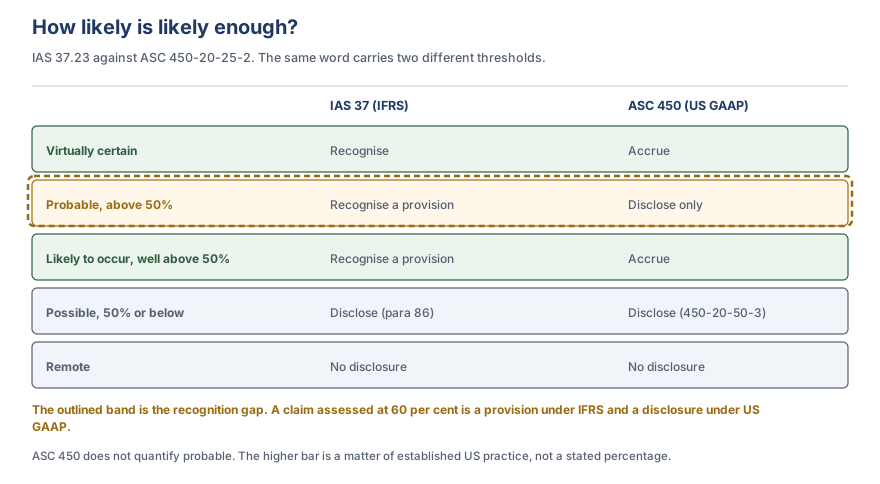
Probable means more likely than not, so anything over 50%. That is a lower bar than the ordinary English word suggests, and much lower than the US GAAP threshold. Where you have many similar obligations, you test the population as a whole, not each item, which is why warranties are provided for even though most individual units never fail.
For a provision to be recognised, it must be probable that an outflow of resources will be required to settle the obligation. An outflow of resources is regarded as probable if the event is more likely than not to occur, that is, the probability that the event will occur is greater than the probability that it will not. Where it is not probable that a present obligation exists, the entity discloses a contingent liability, unless the possibility of an outflow is remote.
Where there are a number of similar obligations, for example product warranties or similar contracts, the probability that an outflow will be required in settlement is determined by considering the class of obligations as a whole. Although the likelihood of outflow for any one item may be small, it may well be probable that some outflow of resources will be needed to settle the class of obligations as a whole. If that is the case, a provision is recognised, if the other recognition criteria are met.
Note the interaction with measurement. Para 24 gets you through the recognition gate on a population basis; para 39 then measures that population at expected value. They are two steps, and the second is covered in Unit 6.
Example 5: 85% of units are fine, and there is still a provision
A manufacturer sells 100,000 units in the year, each with a 12-month warranty. History gives: 85% no defect, 12% a minor repair at GBP 50, 3% a major repair at GBP 300.
Recognition (para 24). For any single unit an outflow is unlikely, at 15%. For the class as a whole an outflow is close to certain. So the recognition test is met at population level and a provision is required.
Measurement (para 39), for completeness. Expected cost per unit = (0.85 × GBP 0) + (0.12 × GBP 50) + (0.03 × GBP 300) = GBP 6.00 + GBP 9.00 = GBP 15.00. Provision = 100,000 × GBP 15.00 = GBP 1,500,000.
| Outcome | Probability | Cost per unit | Weighted |
|---|---|---|---|
| No defect | 85% | GBP 0 | GBP 0.00 |
| Minor repair | 12% | GBP 50 | GBP 6.00 |
| Major repair | 3% | GBP 300 | GBP 9.00 |
| Expected cost per unit | GBP 15.00 |
Journal:
| Dr | Cr | |
|---|---|---|
| Warranty expense (P&L) | GBP 1,500,000 | |
| Warranty provision | GBP 1,500,000 |
Anyone applying the probable test unit by unit would conclude that no outflow is probable for any individual unit, and would recognise nothing. That is the error para 24 exists to prevent.
Local FAQs
Is "probable" 51% or is there a safe harbour? Para 23 defines it as greater than 50%. There is no percentage band, no 60% convention and no safe harbour. Judgement sits in estimating the probability, not in interpreting the word.
Does probable mean the same thing in US GAAP? No, and this is the single largest IFRS to US GAAP difference in this area. ASC 450 uses probable to mean likely to occur, a materially higher hurdle, commonly read in practice as well above 50% although the standard does not quantify it. A claim assessed at 60% is a recognised provision under IAS 37 and a disclosure-only contingency under ASC 450. Full treatment in the IAS 37 vs ASC 450 deep dive.
What if the outflow is exactly 50/50? It is not more likely than not, so the test fails and the item is disclosed as a contingent liability under para 86. In practice a genuine 50/50 assessment invites challenge on whether the analysis is complete.
Potential risks
The population test applied to a single obligation. Para 24 is for classes of similar obligations. Applying expected-value logic to one lawsuit produces a number that could never be paid, and para 40 requires the most likely outcome for a single obligation instead.
A US-trained threshold applied to IFRS accounts. Where a group has US GAAP heritage or US-trained staff, the higher probable bar migrates into IFRS reporting and provisions go unrecognised. It is a systematic understatement, not a one-off error, and it is worth testing directly by asking what threshold the team believes it is applying.
Counsel's language taken at face value. "We will defend this vigorously" is not a probability assessment. Where a lawyer's letter avoids a likelihood, the file needs the entity's own reasoned conclusion against the para 23 test, not a restatement of the lawyer's caution.
How do you measure the best estimate?
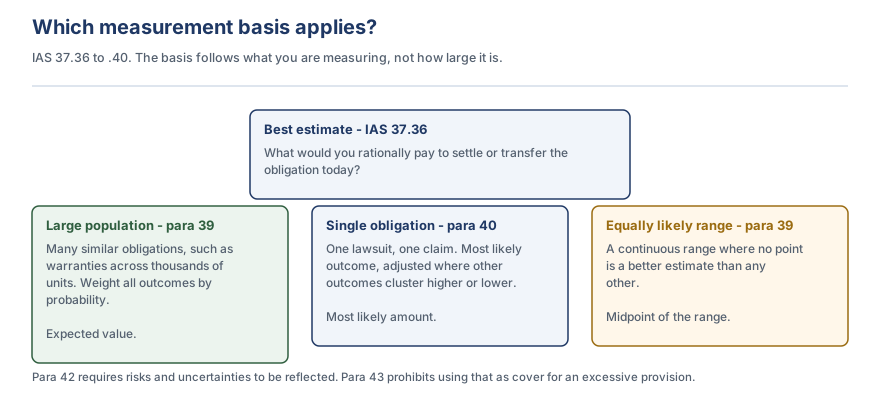
Measure what you would rationally pay today to settle the obligation or hand it to someone else. How you get there depends on what you are measuring. Many similar obligations get probability-weighted. One obligation gets its most likely outcome. A range with no better point in it gets the midpoint.
The amount recognised as a provision shall be the best estimate of the expenditure required to settle the present obligation at the end of the reporting period.
The best estimate is the amount that an entity would rationally pay to settle the obligation at the end of the reporting period or to transfer it to a third party at that time.
Where the provision being measured involves a large population of items, the obligation is estimated by weighting all possible outcomes by their associated probabilities. Where there is a continuous range of possible outcomes, and each point in that range is as likely as any other, the mid-point of the range is used.
Where a single obligation is being measured, the individual most likely outcome may be the best estimate of the liability. However, even in such a case, the entity considers other possible outcomes. Where other possible outcomes are either mostly higher or mostly lower than the most likely outcome, the best estimate will be a higher or lower amount.
The risks and uncertainties that inevitably surround many events and circumstances shall be taken into account in reaching the best estimate. Uncertainty does not justify the creation of excessive provisions or a deliberate overstatement of liabilities.
One question, three routes: is this a large population of similar items, a single obligation, or a continuous range with no better point? Population goes to expected value. Single obligation goes to most likely outcome, adjusted if other outcomes cluster higher or lower. Equally likely range goes to the midpoint.
Example 6: three obligations, three bases
| Obligation | Facts | Basis | Amount |
|---|---|---|---|
| Warranty on 100,000 units | 85% nil, 12% at GBP 50, 3% at GBP 300 | Expected value (para 39) | GBP 1,500,000 |
| Single lawsuit | Most likely award GBP 2m; other outcomes cluster higher, GBP 2m to GBP 5m | Most likely, adjusted upward (para 40) | Above GBP 2m, judgement |
| Single lawsuit, GBP 4m to GBP 12m, no point better | Counsel cannot narrow it | Midpoint (para 39) | GBP 8,000,000 |
The three sit in one standard and produce three different answers on deliberately similar facts. Picking the wrong basis is not a rounding issue.
The warranty provision one year on
Take the GBP 1,500,000 warranty provision from unit 5, and assume 60% of claims are expected in year 1 and 40% in year 2. Claims of GBP 880,000 are actually settled during year 1.
| Movement | Amount |
|---|---|
| Opening provision | 1,500,000 |
| Claims settled, charged against the provision (para 61) | (880,000) |
| Closing balance | 620,000 |
The expected year 2 tranche was GBP 600,000. The closing balance is GBP 620,000, so GBP 20,000 of the year 1 tranche was not used. That difference is not rounding. It is unused provision, and para 59 requires it to be reassessed at the reporting date: either year 2 claims are now expected to be higher than originally estimated, in which case it stays, or the original estimate was too high, in which case the GBP 20,000 is reversed through the same line it was charged to. What is not permitted is leaving it there unexamined.
Local FAQs
Can we build in a margin for prudence? No. Para 43 is explicit that uncertainty does not justify excessive provisions or deliberate overstatement. Prudence is reflected in taking risk into account under para 42, not in adding a cushion on top of the best estimate.
Whose costs do we measure, ours or a third party's? Para 37 gives you both: what you would rationally pay to settle, or to transfer the obligation. In practice you measure your own expected settlement cost, but the transfer test is a useful sanity check on a number that looks too low.
Potential risks
Expected value applied to a single obligation. A probability-weighted lawsuit produces a figure that will never be paid. Para 40 requires the most likely outcome for a single obligation, considered against the spread of other outcomes.
The unused tranche left to sit. As above. A provision that quietly carries surplus from a prior year is the mechanism of cookie-jar reserving, and para 59 is the control against it.
When do you discount a provision, and at what rate?
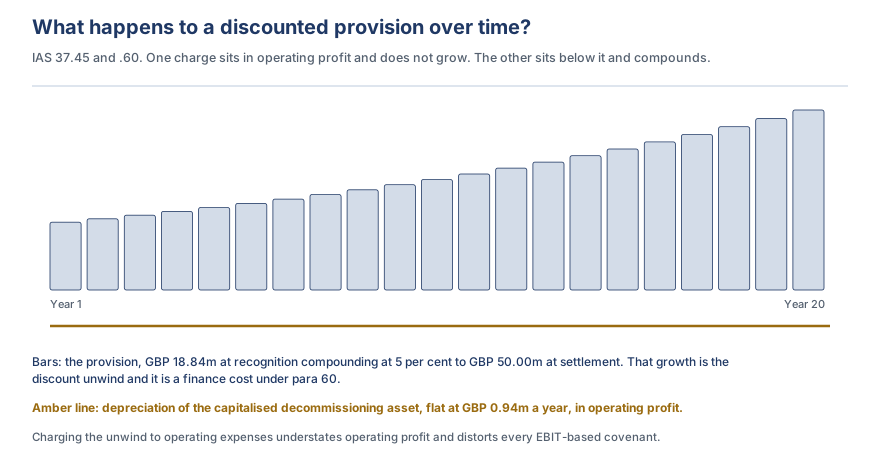
If the money will not be paid for years and the difference is material, you carry the provision at present value. Then it grows each year as the discount unwinds, and that growth is a finance cost, not an operating expense. Getting that last part wrong misstates operating profit even though the balance sheet is right.
Where the effect of the time value of money is material, the amount of a provision shall be the present value of the expenditures expected to be required to settle the obligation.
Because of the time value of money, provisions relating to cash outflows that arise soon after the reporting period are more onerous than those where cash outflows of the same amount arise later.
The discount rate shall be a pre-tax rate that reflects current market assessments of the time value of money and the risks specific to the liability. The discount rate shall not reflect risks for which future cash flow estimates have been adjusted.
Where discounting is used, the carrying amount of a provision increases in each period to reflect the passage of time. This increase is recognised as borrowing cost.
Read para 47 carefully, because it contains a trap. The rate reflects risks specific to the liability, and it must not reflect risks already built into the cash flows. Adjust the cash flows for a risk and then load the same risk into the rate and you have double counted it. Auditors test for exactly this.
Example 7: a decommissioning provision, from recognition to the first unwind
A company brings an offshore platform into use on 1 January 20X1. The licence requires the seabed to be restored at the end of the platform's 20-year life. Best estimate of the restoration cost in 20 years: GBP 50,000,000. Pre-tax risk-adjusted rate: 4%.
Present value = GBP 50,000,000 / (1.04)^20 = GBP 50,000,000 / 2.19112 = GBP 22,819,352.
The obligating event is the installation of the platform, so under IAS 16.16(c) the discounted cost is capitalised into the asset and depreciated over its life, with a matching provision.
| 1 January 20X1 | Dr | Cr |
|---|---|---|
| PP&E, decommissioning component | 22,819,352 | |
| Decommissioning provision | 22,819,352 |
| 31 December 20X1 | Dr | Cr |
|---|---|---|
| Depreciation, operating (22,819,352 / 20) | 1,140,968 | |
| Accumulated depreciation | 1,140,968 | |
| Finance cost, discount unwind (22,819,352 x 4%) | 912,774 | |
| Decommissioning provision | 912,774 |
The provision closes at GBP 23,732,126 and compounds at 4% until it reaches GBP 50,000,000 in year 20. Note the split: GBP 1,140,968 sits in operating profit as depreciation and GBP 912,774 sits below it as a finance cost. The two are not the same number and there is no reason they should be. Depreciation spreads the capitalised cost evenly over the life of the asset, while the unwind grows the liability at the discount rate from a smaller opening base. The two are equal here only because the 20-year life gives a 5% depreciation rate that happens to match the discount rate. That coincidence does not generalise.
A waterfall running left to right from the GBP 18.8m initial provision to the GBP 50m settlement, each bar the annual unwind, with the operating charge (depreciation) shown as a separate flat band beneath, so a reader can see that one line grows and the other does not.
Where firms differ: the discount rate, and whether your own credit risk belongs in it
IAS 37.47 asks for a pre-tax rate reflecting current market assessments of the time value of money and the risks specific to the liability. It does not give you a rate, and it does not settle whether your own credit standing is one of those risks. KPMG describes current practice as mixed: some companies use a risk-free rate, others adjust it for non-performance or their own credit risk.
On a thirty-year liability the choice is not cosmetic. A single percentage point moves the carrying amount by roughly a quarter, which is larger than most of the cost-estimate revisions that get all the audit attention.
ED/2024/8 would settle it one way: a risk-free rate with no further adjustment. KPMG's warning about the consequence is the part worth acting on. Provisions currently measured at risk-adjusted rates would get larger, and a distant decommissioning obligation a company today treats as immaterial could become material enough to require recognition.
My view: if you adjust for own credit risk, treat it as a live exposure rather than settled policy, and work out now what the risk-free basis does to your closing balance. Finding out during transition leaves no room to do anything about it.
KPMG IFRG Limited, Provisions: major accounting changes on the horizon, 2024. IASB Exposure Draft ED/2024/8 Provisions: Targeted Improvements, November 2024.Real company: Shell plc, 2023: a discount rate move worth USD 2.9bn
Shell's 2023 Annual Report and Accounts discloses a discount rate of 4.5% at 31 December 2023 (2022: 3.25%) for its decommissioning and other provisions. The rate change alone decreased total provisions by USD 2,916 million, of which USD 2,777 million related to the decommissioning and restoration provision, partly offset by an increase of USD 1,340 million from changes in cost estimates.
That is IAS 37.45 to .47 and IFRIC 1 in one movement. No cash moved and no decommissioning work changed. A single input moved, and a provision measured in tens of billions moved with it. It is the clearest available demonstration of why the discount rate is the assumption auditors test hardest on a long-dated provision.
Source: Shell plc Annual Report and Accounts 2023, consolidated financial statements, note “Decommissioning and other provisions”. Figures as disclosed.Local FAQs
Is a warranty provision discounted? Only if the effect is material (para 45). Warranties usually settle inside a year or two so the effect is small, but a five-year warranty on capital equipment should be discounted and unwound.
Where does the unwind go in the income statement? Finance costs, under para 60. Not operating expenses, and not in the same line as the original charge. Under IFRS 18 from 2027 this becomes structurally visible, because the unwind lands in the financing category while the original provision charge lands in operating.
Potential risks
Long-dated provisions carried undiscounted. Overstates the liability and understates finance cost, and inflates the operating result relative to a peer that discounts. Common on dilapidations and environmental obligations.
Risk double counted. Cash flows loaded for risk and then discounted at a risk-adjusted rate. Para 47 prohibits it and it materially understates the provision.
The unwind misclassified as operating. Understates operating profit and distorts every operating margin and EBIT-based covenant.
Which future events can you build into the estimate, and which can you not?
You can reflect future events that will affect the amount, where there is good evidence they will happen. You cannot reflect a gain you expect to make on selling an asset, even if the sale is part of the same plan.
Future events that may affect the amount required to settle an obligation shall be reflected in the amount of a provision where there is sufficient objective evidence that they will occur. Expected future changes in the law shall be reflected only where there is sufficient objective evidence that the law will be enacted.
The effect of possible new legislation is taken into consideration in measuring an existing obligation when sufficient objective evidence exists that the legislation is virtually certain to be enacted.
Gains from the expected disposal of assets shall not be taken into account in measuring a provision, even if the expected disposal is closely linked to the event giving rise to the provision. Instead, an entity recognises gains on expected disposals of assets at the time specified by the Standard dealing with the assets concerned.
Example 8: the clean-up technology and the site sale
A company must remediate a contaminated site. Two facts are in play.
(a) A new remediation technology. A cheaper method is in commercial use elsewhere and the company has already contracted for it. Sufficient objective evidence exists, so the cost reduction is reflected in the provision (para 48).
(b) The site will be sold after remediation for a GBP 4m gain. The sale is part of the same board-approved plan. It is still excluded (para 51). The provision is measured gross and the gain is recognised on disposal under IAS 16.
Netting the GBP 4m against the provision understates the liability and pulls a disposal gain forward into a year in which nothing has been sold.
Local FAQs
Can we assume technological improvement that has not happened yet? Only with sufficient objective evidence, which means something more than an expectation. A pilot, a contract, or established use by others gets you there. A hope of future efficiency does not.
What about a law that is going through parliament? Para 50 sets the bar at virtually certain to be enacted. In UK terms that is very late in the process, and a bill at an early stage does not qualify.
Potential risks
Disposal gains netted off. The most common form of this error, and it produces an understated provision and an early gain in one move.
Optimistic future assumptions with no evidence. Cost reductions built on planned efficiencies that do not yet exist. Para 48 requires objective evidence, and the audit response is to ask for it.
Can you offset an insurance recovery against a provision?
Not on the balance sheet. If you are virtually certain to be reimbursed, you recognise a separate asset, capped at the provision. The two can be netted in the income statement but never against each other in the statement of financial position.
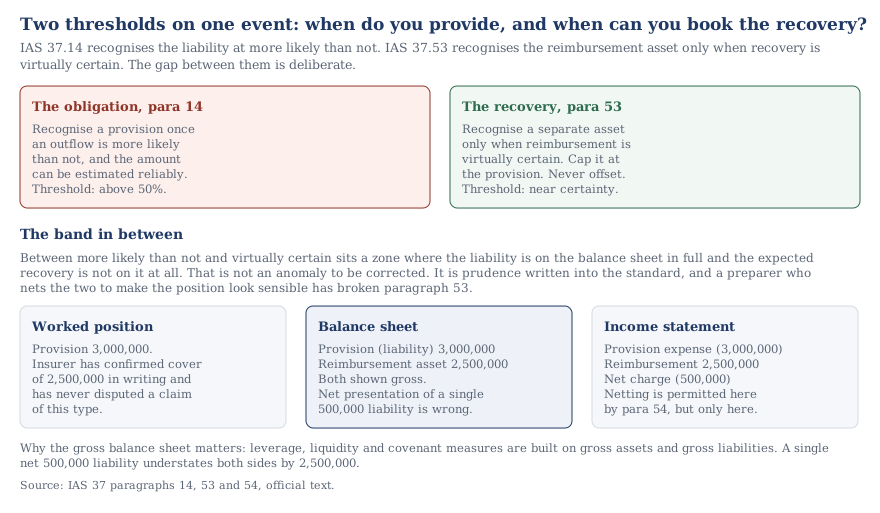
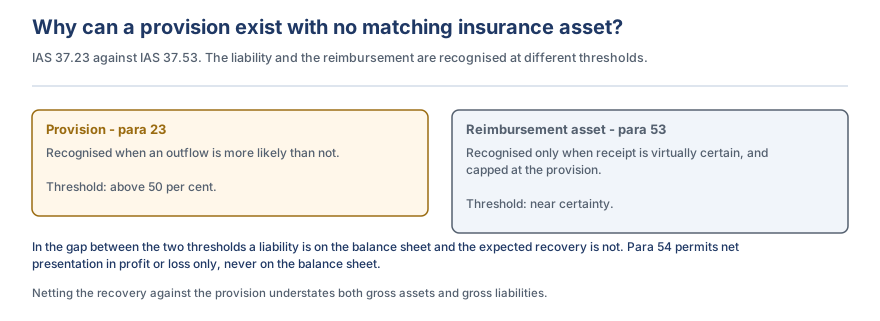
Where some or all of the expenditure required to settle a provision is expected to be reimbursed by another party, the reimbursement shall be recognised when, and only when, it is virtually certain that reimbursement will be received if the entity settles the obligation. The reimbursement shall be treated as a separate asset. The amount recognised for the reimbursement shall not exceed the amount of the provision.
In the statement of comprehensive income, the expense relating to a provision may be presented net of the amount recognised for a reimbursement.
Note the asymmetry. The provision goes on at more likely than not (para 23). The reimbursement asset goes on only at virtually certain. The thresholds are deliberately different, which means a claim you probably will win does not come on at all.
Example 9: GBP 3m claim, GBP 2.5m insured
A company recognises a GBP 3,000,000 provision for a product liability claim. Its insurer has confirmed cover in writing for GBP 2,500,000 and has never disputed a claim of this type.
| Balance sheet | Amount |
|---|---|
| Provision (liability) | 3,000,000 |
| Reimbursement asset, separate (para 53) | 2,500,000 |
| Income statement (para 54 presentation permitted) | Amount |
|---|---|
| Provision expense | (3,000,000) |
| Insurance reimbursement | 2,500,000 |
| Net charge | (500,000) |
The balance sheet shows both. Showing a single net GBP 500,000 liability understates both gross assets and gross liabilities, which matters to any leverage or liquidity measure built on gross figures.
Real company: Bayer, 2025 to 2026: remeasurement, and the limit of an insurance recovery
Bayer disclosed provisions and liabilities for litigation of EUR 7.8 billion at 30 September 2025, of which EUR 6.5 billion related to glyphosate. Following settlement agreements reached in February 2026, including a proposed US nationwide class settlement, the reported figure rose to EUR 11.8 billion, of which EUR 9.6 billion related to glyphosate.
Two IAS 37 mechanics sit on top of each other here. Para 36 requires the best estimate at each reporting date and para 59 requires it to be revised as the picture changes. That is why a number can move by billions without the earlier figure having been wrong when it was made.
Bayer also states that it is insured against statutory product liability claims to the extent customary in its industries, but that the accounting measures relating to Roundup exceed the available insurance. Para 53 is why that sentence matters. A reimbursement is recognised as a separate asset only when recovery is virtually certain, it is capped at the amount of the provision, and it is never netted off.
Bayer AG, Annual Report 2024 and Quarterly Statement Q1 2026, legal risks disclosure. Figures as reported.Local FAQs
The insurer has not confirmed yet but always pays. Virtually certain? Past practice supports it but the assessment is claim-specific. If cover for this claim type has not been confirmed and the policy has exclusions in point, virtually certain is hard to argue.
Can the asset exceed the provision if we expect a profit on the claim? No. Para 53 caps it at the provision. Any excess is a contingent asset under para 31 and is not recognised.
Potential risks
Net presentation on the balance sheet. Prohibited, and it understates both sides. Frequently found where the finance team thinks in terms of net exposure.
Reimbursement recognised at probable. Applying the para 23 threshold to the asset instead of the para 53 one overstates assets and understates the net charge.
What happens to a provision after you book it?
You revisit it every reporting date and adjust it to the current best estimate. If it is no longer needed, it comes out. And you can only spend it on the thing you set it up for.
Provisions shall be reviewed at the end of each reporting period and adjusted to reflect the current best estimate. If it is no longer probable that an outflow of resources embodying economic benefits will be required to settle the obligation, the provision shall be reversed.
A provision shall be used only for expenditures for which the provision was originally recognised. Only expenditures that relate to the original provision are set against it. Setting expenditures against a provision that was originally recognised for another purpose would conceal the impact of two different events.
Example 10: the warranty provision that absorbs a restructuring cost
A company holds a GBP 1,500,000 warranty provision. During the year it incurs GBP 400,000 of redundancy costs and charges them against the warranty provision, on the basis that the warranty provision is "over-provided anyway".
Two balances are now wrong at once. The warranty provision is understated by GBP 400,000 relative to the obligation it actually covers, and the redundancy cost has never appeared in the income statement. Para 62 exists precisely to stop this, because it conceals the impact of two separate events. The correct treatment is to charge the redundancy to profit or loss, and separately to reassess the warranty provision under para 59.
Local FAQs
Is a reversal a prior-period error? No. A change in the best estimate is a change in accounting estimate, recognised in the current period. It only becomes an error if the original estimate was not supportable on the information available at the time.
Does the reversal go to the same line as the original charge? Yes, ordinarily. A warranty provision reversal reduces the warranty expense line rather than creating other income, so the reader can see the movement in context. Para 84 requires unused amounts reversed to be shown separately in the reconciliation regardless.
Potential risks
Provisions used as a general reserve. The para 61 breach above. It is one of the clearest indicators of earnings management in this area and it is testable by vouching what was actually charged against each provision.
Stale provisions never reassessed. A provision carried forward unchanged for several years, with no movement other than the unwind, is either wrong or unexamined. Para 59 requires a positive reassessment every period, not silence.
Can you provide for future operating losses?
No. Never. A loss you expect to make next year is not an obligation from a past event. If you expect losses, the accounting question is whether your assets are impaired, not whether you can provide for the loss.
Provisions shall not be recognised for future operating losses.
An expectation of future operating losses is an indication that certain assets of the operating unit may be impaired. An entity tests these assets for impairment under IAS 36.
This is the shortest rule in the standard and one of the most useful, because it redirects the question. The instinct on a loss-making division is to provide. The correct response is an IAS 36 impairment test on the cash-generating unit.
Example 11: the loss-making division
A division is forecast to lose GBP 5m over the next three years. Management wants to provide GBP 5m now to "clear the decks".
No provision. There is no past event and no present obligation; the losses arise from continuing to operate, which is avoidable by future action (para 19 again). What para 64 requires instead is an impairment test on the division as a CGU under IAS 36, comparing its carrying amount to the higher of fair value less costs of disposal and value in use. If the forecast losses mean the carrying amount is not recoverable, an impairment loss is recognised, allocated to goodwill first and then pro rata under IAS 36.104.
The distinction matters commercially. A GBP 5m provision would sit as a liability and release into future profit, flattering later years. An impairment writes assets down permanently for goodwill and reduces future depreciation, which is a different economic story.
Local FAQs
What if the losses arise under a contract we cannot exit? Then you may have an onerous contract, which is a different question with a different answer (unit 12). Para 63 blocks a provision for operating losses generally; para 66 requires one where a specific contract's unavoidable costs exceed its benefits.
Can we provide for the cost of closing the division? Only if the para 72 restructuring conditions are met (unit 13), and only for the qualifying direct costs. Not for the operating losses up to the closure date, which para 82 excludes explicitly.
Potential risks
The big bath. A provision for expected future losses booked in a bad year, released in good ones. Prohibited outright by para 63 and one of the reasons the standard exists in its current form.
The impairment test skipped. Para 64 is a requirement, not a suggestion. A file that declines a provision on para 63 grounds and then does not test for impairment has answered half the question.
What is an onerous contract, and how much do you provide?
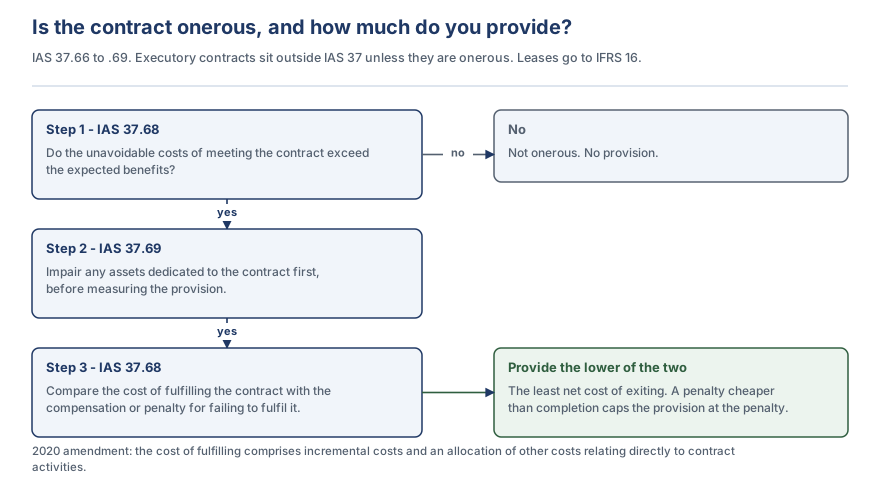
When the unavoidable costs of doing what you promised exceed what you will get for it. You provide the cheaper of finishing the job and paying to walk away. And you impair any assets used in fulfilling the contract before you measure the provision, not after.
If an entity has a contract that is onerous, the present obligation under the contract shall be recognised and measured as a provision. The unavoidable costs under a contract reflect the least net cost of exiting from the contract, which is the lower of the cost of fulfilling it and any compensation or penalties arising from failure to fulfil it.
Before a separate provision for an onerous contract is established, an entity recognises any impairment loss that has occurred on assets used in fulfilling the contract.
The IASB amended IAS 37 in 2020 to specify that the cost of fulfilling a contract comprises the costs that relate directly to the contract: both the incremental costs, such as direct labour and materials, and an allocation of other costs that relate directly to contract activities, such as depreciation of equipment used in fulfilling that contract and others. The amendment closed a divergence where some entities used incremental costs only and therefore under-provided.
Example 12: fulfil or exit
A manufacturer is committed to buy 10,000 components at GBP 12 each, GBP 120,000 in total. Demand has collapsed and the finished goods will realise net proceeds of only GBP 100,000. The contract carries a cancellation penalty of GBP 15,000.
| Route | Cost |
|---|---|
| Cost of fulfilling (120,000 cost less 100,000 benefit) | 20,000 |
| Cost of exiting (penalty) | 15,000 |
| Provision, the lower of the two (para 68) | 15,000 |
| Dr | Cr | |
|---|---|---|
| Onerous contract expense | 15,000 | |
| Provision | 15,000 |
Any components already on hand are written down first under IAS 2, and any equipment dedicated to the contract is tested under IAS 36, before this provision is measured (para 69).
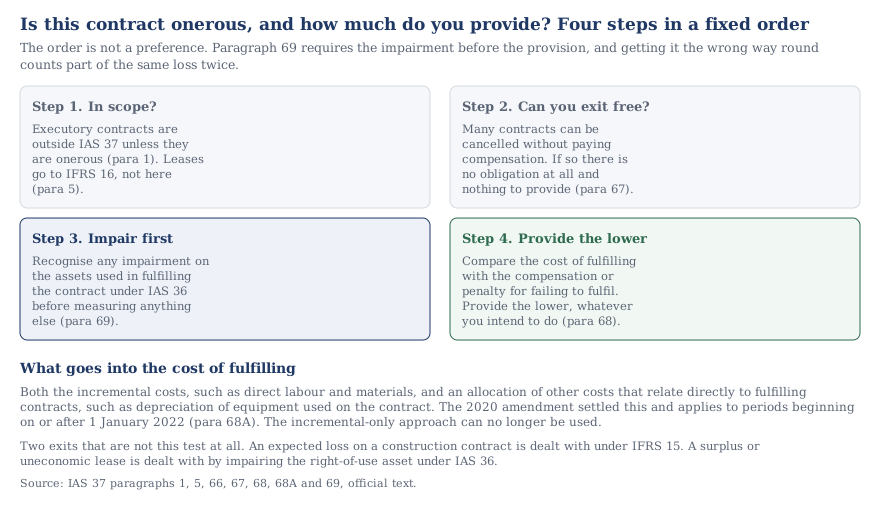
The full treatment, including the allocation mechanics introduced by the 2020 amendment and how the test works on long-term service contracts, is on the spoke: onerous contracts under IAS 37.
Real company: Rolls-Royce, 2024: when a thin contract becomes an onerous one
Rolls-Royce reported net onerous provision charges of GBP 55m for 2024, against GBP 25m in 2023. Within the movement, GBP 382m of additional charges were largely associated with prolonged supply chain problems and were booked across onerous provisions and contract catch-ups. Its Civil Aerospace long-term service agreements are accounted for under IFRS 15 and IAS 37 together.
No contract term changed. Supplier prices rose, so the incremental cost of fulfilling rose, the allocated share of other directly related costs rose with it, and contracts that were merely thin became onerous. That is para 68A operating in a live business rather than in an example.
Rolls-Royce Holdings plc, 2024 Full Year Results. Figures as reported.Where firms differ: which costs go into a provision at all
IAS 37.68A settles what goes into the cost of fulfilling a contract. It says nothing about any other provision, and KPMG states the gap plainly: IAS 37 provides no specific guidance on which costs to include in measuring a provision, so approaches vary with the nature of the provision and the entity's own policy.
That produces two answers in one balance sheet. An onerous contract provision takes incremental costs plus an allocation of other directly related costs, because para 68A requires it. A legal claim provision in the same accounts is often measured on incremental costs alone, external lawyers and the payment to the claimant, with nothing for the in-house team that will spend two years on the file.
ED/2024/8 would apply one basis, all direct costs, to every provision.
My view: para 68A is the only defensible basis for onerous contracts today. Where your legal, warranty and restructuring provisions sit on a narrower basis, say so in the accounting policy note. A reader is otherwise entitled to assume one basis runs through the whole note, and it usually does not.
KPMG IFRG Limited, Provisions: major accounting changes on the horizon, 2024. IASB Exposure Draft ED/2024/8 Provisions: Targeted Improvements, November 2024.Local FAQs
Does IAS 37 apply to all our contracts? No. Executory contracts are outside the standard unless they are onerous. A profitable or break-even contract generates no provision.
Is a loss-making lease an onerous contract? No, not under IAS 37. Leases are within IFRS 16, and the answer there is to test the right-of-use asset for impairment under IAS 36.
Potential risks
Incremental costs only. The pre-2020 practice, which understates the provision by excluding directly related allocated costs. Any model built before the amendment needs re-running.
Assets not impaired first. Para 69 sequences this deliberately. Providing before impairing double counts part of the loss and puts it on the wrong line.
Is a board decision enough to provide for a restructuring?
No. You need a detailed formal plan and you need to have told the people affected, either by announcing it or by starting to do it. Until then the plan is reversible and there is no obligation. And even once it qualifies, most of what management calls restructuring cost cannot go in the provision.
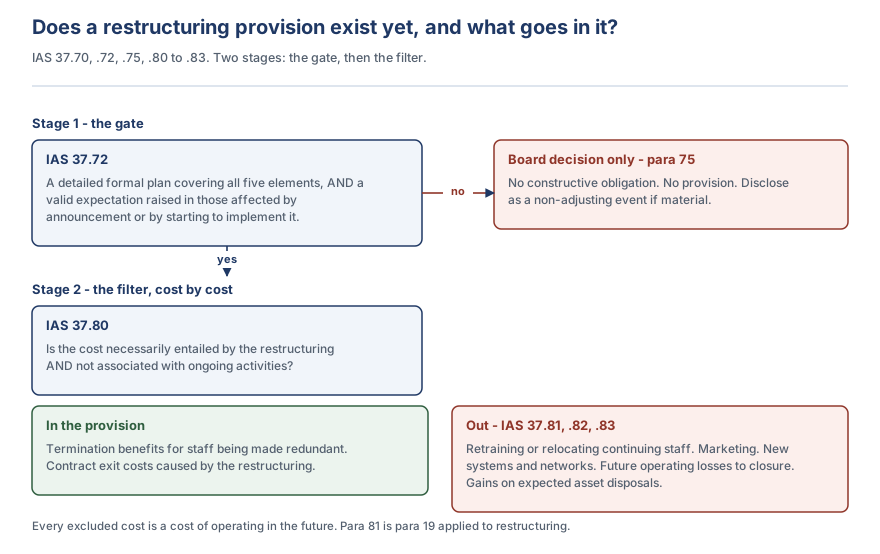
A constructive obligation to restructure arises only when an entity has a detailed formal plan for the restructuring identifying at least the business or part of a business concerned, the principal locations affected, the location, function and approximate number of employees who will be compensated for terminating their services, the expenditures that will be undertaken, and when the plan will be implemented; and has raised a valid expectation in those affected that it will carry out the restructuring by starting to implement that plan or announcing its main features to those affected by it.
A management or board decision to restructure taken before the end of the reporting period does not give rise to a constructive obligation at the end of the reporting period unless the entity has, before the end of the reporting period, started to implement the restructuring plan, or announced the main features of the restructuring plan to those affected by it in a sufficiently specific manner to raise a valid expectation in them that the entity will carry out the restructuring.
A restructuring provision shall include only the direct expenditures arising from the restructuring, which are those that are both necessarily entailed by the restructuring and not associated with the ongoing activities of the entity. A restructuring provision does not include such costs as retraining or relocating continuing staff, marketing, or investment in new systems and distribution networks. Nor does it include future operating losses, or gains on the expected disposal of assets.
The rule you have already met
Look at what para 81 excludes: retraining, relocating continuing staff, marketing, new systems. Every one of those is a cost of operating in the future, and every one is avoidable by future action. That is para 19 from unit 3, applied to restructuring. These are not two lists to memorise. The second is the first, in a specific setting. Once you see that, you can work out what qualifies without checking para 81, because the question is always the same: does this cost arise from the past decision, or from continuing to run the business?
Example 13: the same closure, two reporting dates
A group's board approves the closure of a plant on 15 December. It announces the closure to employees and their representatives on 20 January. Year end is 31 December.
| Date | Position |
|---|---|
| 31 December | Detailed formal plan exists, but nothing has been announced and nothing implemented. Para 75: no constructive obligation. No provision. Disclose as a non-adjusting event under IAS 10 if material. |
| Following 31 December | Announcement made 20 January, obligation now exists. Provision recognised in the following period, for qualifying direct costs only. |
Had the announcement been made on 20 December instead, the provision would fall in the earlier year. A five-week difference in a communication date moves a material charge between two sets of accounts.
Two stages. Stage one, the gate: is there a detailed formal plan with all five para 72 elements, and has it been announced to those affected or started? Both yes, proceed. Either no, no provision. Stage two, the filter: for each cost, is it necessarily entailed by the restructuring and not associated with ongoing activities? In, if yes. Out, if it is retraining, relocation, marketing, new systems, future operating losses or a disposal gain.
The full treatment, including the interaction with IAS 19 termination benefits and the ASC 420 comparison, is on the spoke: restructuring provisions under IAS 37.
Local FAQs
Is a leaked plan an announcement? Para 75 requires the main features to be communicated in a sufficiently specific manner to raise a valid expectation. A leak may in substance do that, and it is a facts question, but a rumour is not an announcement.
Do we announce to employees or to the market? To those affected. Employees and their representatives are the usual audience; a market announcement of a specific plan can also raise a valid expectation.
Potential risks
A provision on a board minute alone. The most common error in this area, and para 75 addresses it directly. Obtain the dated evidence of announcement or implementation and confirm it pre-dates the reporting date.
The provision padded with excluded costs. Retraining, relocation, marketing, new systems, operating losses to closure and disposal gains. Recompute the provision stripped of these; where it falls materially, the original number was not a restructuring provision.
What must you disclose about provisions and contingent liabilities?
A movement reconciliation for every class of provision, a description of what it is and when you expect to pay it, and the uncertainties around it. Contingent liabilities get described but not recognised. And there is one narrow exit: if disclosure would seriously prejudice your position in a dispute, you can withhold the detail, but you cannot go silent.
For each class of provision, an entity shall disclose the carrying amount at the beginning and end of the period, additional provisions made in the period including increases to existing provisions, amounts used during the period, unused amounts reversed during the period, and the increase during the period in the discounted amount arising from the passage of time and the effect of any change in the discount rate. Comparative information is not required.
An entity shall disclose, for each class of provision, a brief description of the nature of the obligation and the expected timing of any resulting outflows of economic benefits, an indication of the uncertainties about the amount or timing of those outflows, and the amount of any expected reimbursement, stating the amount of any asset that has been recognised for that expected reimbursement.
Unless the possibility of any outflow in settlement is remote, an entity shall disclose for each class of contingent liability a brief description of its nature and, where practicable, an estimate of its financial effect, an indication of the uncertainties relating to the amount or timing of any outflow, and the possibility of any reimbursement.
Where an inflow of economic benefits is probable, an entity shall disclose a brief description of the nature of the contingent assets and, where practicable, an estimate of their financial effect.
In extremely rare cases, disclosure of some or all of the information required can be expected to prejudice seriously the position of the entity in a dispute with other parties on the subject matter of the provision, contingent liability or contingent asset. In such cases, an entity need not disclose the information, but shall disclose the general nature of the dispute, together with the fact that, and reason why, the information has not been disclosed.
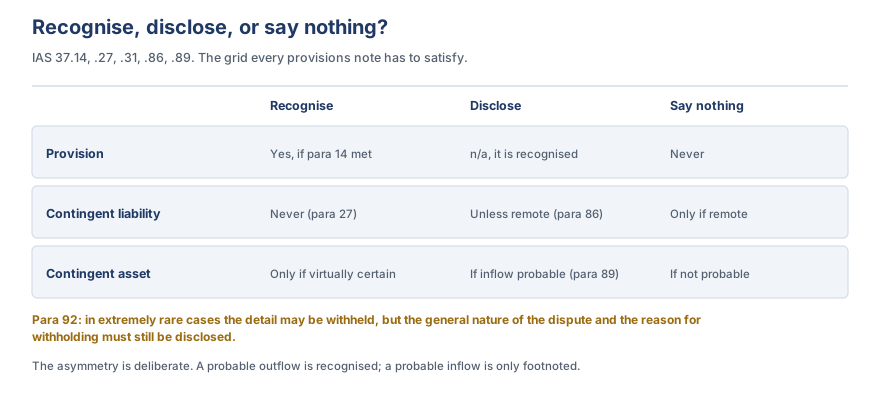
A single grid: rows for provision, contingent liability, contingent asset; columns for recognise, disclose, say nothing. Each cell carrying the paragraph reference and the likelihood threshold that puts you there, so the recognise-versus-disclose boundary is visible in one view.
Example 14: the reconciliation, built
| Warranty | Restructuring | Total | |
|---|---|---|---|
| At 1 January | 1,500,000 | - | 1,500,000 |
| Additional provisions, including increases | 1,620,000 | 900,000 | 2,520,000 |
| Amounts used | (1,480,000) | (620,000) | (2,100,000) |
| Unused amounts reversed | (20,000) | - | (20,000) |
| Discount unwind | - | - | - |
| At 31 December | 1,620,000 | 280,000 | 1,900,000 |
That GBP 20,000 reversal is the unused year 1 warranty tranche from unit 6, and para 84 requires it to be shown as a reversal rather than netted into amounts used. Netting it would hide the fact that the prior estimate was too high, which is precisely the information the line exists to give.
The full treatment, including a model note and the paragraph 92 exemption in practice, is on the spoke: IAS 37 disclosure requirements.
Real company: Volkswagen Group, 2024: the provision and the contingency, side by side
Volkswagen's 2024 annual report shows both halves of IAS 37 on one matter. Around EUR 0.6 billion sits in provisions for litigation and legal risks at 31 December 2024 for the currently known legal risks on the diesel issue, while EUR 4.0 billion is disclosed as contingent liabilities, of which EUR 3.8 billion relates to investor lawsuits in Germany.
Same event, two treatments, decided entirely by paragraph 14. Where an outflow is probable and measurable, a provision. Where it is not, disclosure under paragraph 86 and nothing on the balance sheet. Paragraph 88 requires the link between the two to be visible, which is why they appear in the same discussion rather than forty pages apart.
Volkswagen also applies the paragraph 92 exemption explicitly, stating that in line with IAS 37.92 no further statements are made on estimates of financial impact or on uncertainty as to amount or maturity for additional important legal cases, so as not to compromise the proceedings or the interests of the company. General nature disclosed, quantification withheld, reason given.
On warranties, Volkswagen's provisions note describes obligations arising from sales as covering all risks relating to the sale of vehicles, components and genuine parts, primarily warranty obligations "calculated on the basis of losses to date and estimated future losses". That is paragraphs 24 and 39 in a company's own words: a large population of similar obligations, recognised because an outflow is probable for the class as a whole, measured by weighting outcomes from historical claims experience.
Source: Volkswagen Group Annual Report 2024, notes to the consolidated financial statements: contingent liabilities, litigation, and other provisions. Figures as disclosed.Local FAQs
Do we need comparatives for the reconciliation? No. Para 84 says comparative information is not required. It is a small relief and it is frequently missed in both directions, with some entities giving comparatives unnecessarily and others omitting required current-year lines.
Can we disclose nothing at all about a sensitive lawsuit? No. Para 92 lets you withhold the detail, not the existence. You must still disclose the general nature of the dispute and the fact that, and reason why, information has been withheld.
Potential risks
Reversals netted into amounts used. Hides estimate quality and breaches para 84. One of the most common disclosure faults in this area.
Para 92 over-used. The standard says extremely rare cases. A group invoking it across a portfolio of ordinary litigation has misread it, and the disclosure is deficient.
Boilerplate uncertainty narrative. Para 85 requires an indication of the actual uncertainties. A sentence that would apply to any provision at any company tells the reader nothing.
What do people get wrong most often?
- A provision raised for a cost the entity can still avoid by changing what it does (para 19). Future repairs, future training and future relocation are the usual candidates.
- The probable test applied unit by unit on a population of similar obligations, so nothing is recognised (para 24).
- An insurance recovery netted against the provision instead of shown as a separate asset at virtually certain (paras 53, 54).
- The discount unwind charged to operating expenses rather than as a borrowing cost (para 60).
- A provision used for expenditure it was not raised for (paras 61, 62).
- A restructuring provision on a board decision that has not been announced or started (para 75).
- The intended route measured on an onerous contract rather than the lower of fulfilling and exiting (para 68).
- A provision left standing after the obligation has gone, because nothing forces a reassessment (para 59).
- Expected disposal gains netted into a provision (paras 51, 83).
- A contingent liability disclosed where the obligation is in fact present and only the amount is uncertain (paras 13, 14).
What should you remember from this page?
- A provision needs a present obligation from a past event, a probable outflow and a reliable estimate. All three, every time (para 14).
- Probable means more likely than not, and on a population of similar obligations the test is applied to the class, not the item (paras 23, 24).
- Measure at the best estimate: expected value for a population, most likely outcome for a single obligation, midpoint where a continuous range has no better point (paras 36, 39, 40).
- Discount where the time value of money is material, at a pre-tax rate reflecting the risks specific to the liability, and never double count risk (paras 45, 47).
- A reimbursement is a separate asset at virtually certain, capped at the provision, never offset on the balance sheet (para 53).
- Review every provision at each reporting date and reverse it when the obligation goes (para 59).
- You cannot provide for future operating losses, and an onerous contract is the exception that proves the rule (paras 63, 66).
- A restructuring obligation needs a detailed formal plan and a valid expectation raised in those affected (para 72).
- Disclose the movement reconciliation by class, the narrative behind each class, and the link to any related contingency (paras 84, 85, 88).
Frequently asked questions
Is IAS 37 the same as IFRS 37?
No. There is no standard called IFRS 37. Provisions under international standards are governed by IAS 37, which was never renumbered when the IFRS series began. Around 500 searches a month use the wrong name. The US GAAP equivalent is ASC 450 Contingencies.
What is a provision under IAS 37?
A provision is a liability of uncertain timing or amount (IAS 37.10). It is recognised only when there is a present obligation from a past event, an outflow is probable, and the amount can be estimated reliably (IAS 37.14). Fail any one test and it is a contingent liability or nothing.
What does probable mean in IAS 37?
More likely than not, meaning a probability greater than 50 per cent (IAS 37.23). This is a lower threshold than ASC 450 in US GAAP, where probable means likely to occur and is read in practice as a materially higher bar.
Where do contingent liabilities appear in the financial statements?
Not on the balance sheet. IAS 37.27 prohibits recognising a contingent liability. It is disclosed in the notes under IAS 37.86, with the nature of the obligation, an estimate of the financial effect where practicable, and the uncertainties, unless the possibility of any outflow is remote.
What is the difference between a provision and a contingent liability?
A provision meets all three IAS 37.14 tests and is recognised on the balance sheet. A contingent liability fails at least one, so it is disclosed under IAS 37.86 but not recognised, unless the possibility of outflow is remote in which case nothing is disclosed.
Can you recognise a contingent asset?
No. IAS 37.31 prohibits recognition. A contingent asset is disclosed only where an inflow is probable (IAS 37.89), and recognised only once realisation is virtually certain, at which point it is no longer contingent.
What discount rate applies to a provision?
A pre-tax rate reflecting current market assessments of the time value of money and the risks specific to the liability, without double counting risks already reflected in the cash flows (IAS 37.47). The annual unwind is a finance cost (IAS 37.60).
Can you provide for future operating losses?
No. IAS 37.63 prohibits it, because there is no present obligation from a past event. IAS 37.64 redirects the question: an expectation of future operating losses is an indicator that assets may be impaired under IAS 36.
Is a board decision enough for a restructuring provision?
No. IAS 37.75 requires the entity to have started implementing the plan or announced its main features to those affected before the reporting date. A detailed formal plan alone does not create a constructive obligation.
When can an entity withhold provision disclosures?
Only in extremely rare cases where disclosure would seriously prejudice its position in a dispute (IAS 37.92). Even then the general nature of the dispute, and the fact that and reason why information has been withheld, must still be disclosed.
About UQ Consulting
UQ Consulting is an independent technical reference for accounting and audit practitioners, covering IFRS, UK GAAP and US GAAP. Every technical assertion on this site carries a paragraph reference to the standard, and only currently effective guidance is presented as the accounting treatment; superseded standards appear as history or comparison only.
Written and reviewed by Usman Qureshi (ACCA), a Chartered Certified Accountant with a Big 4 audit and advisory background, and founder of UQ Consulting.
Disclaimer. Educational content, not professional advice. Provision recognition and measurement require significant judgement. Paragraph references are to IAS 37 as in force at the date of review. Company figures are drawn from the cited filings. Consult a qualified accountant for your circumstances.