What makes a contract onerous?
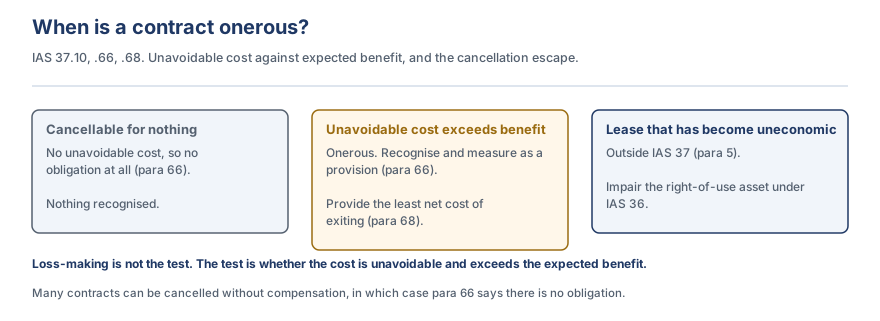
A contract is onerous when what you must unavoidably spend to honour it exceeds what you will get back from it. Not merely unprofitable in hindsight, and not just a contract you regret. The unavoidable costs have to exceed the expected economic benefits.
An onerous contract is a contract in which the unavoidable costs of meeting the obligations under the contract exceed the economic benefits expected to be received under it.
If an entity has a contract that is onerous, the present obligation under the contract shall be recognised and measured as a provision.
Para 67. Many contracts, for example some routine purchase orders, can be cancelled without paying compensation to the other party, and therefore there is no obligation at all in those cases.
That cancellation point matters more than it looks. If you can walk away for nothing, there is nothing to provide.
The unavoidable costs under a contract reflect the least net cost of exiting from the contract, which is the lower of the cost of fulfilling it and any compensation or penalties arising from failure to fulfil it.
Example 1: three contracts, one onerous
| Contract | Position | Onerous? |
|---|---|---|
| Supply agreement, cancellable on 30 days notice with no penalty | Can exit for nothing | No. No unavoidable cost (para 66) |
| Fixed-price construction contract now expected to lose GBP 800k | Cannot exit; loss unavoidable | Yes. Provide, but see IFRS 15 first for contract assets |
| Office lease now surplus to requirements | Cannot exit, but leases are outside IAS 37 | No, not here. Test the right-of-use asset under IAS 36 (unit 5) |
Real company: Siemens Energy, 2024: what the test looks like in a real accounting policy
Siemens Energy states that it records a provision for onerous contracts with customers when the current estimated total costs exceed the estimated revenues, and that onerous contracts are identified by monitoring the progress of each project and updating the estimates. It names the judgements involved: achieving performance standards, warranty costs, and project delays.
Read what the policy does not say. It does not say a provision is raised when a contract looks unprofitable, or when management expects a loss. It is total estimated cost against total estimated revenue, monitored continuously, and once the estimates are set the trigger is arithmetic.
The judgement therefore sits in the estimates, not in the decision to provide. That is where a reviewer or an auditor should be looking, and it is the opposite of where most challenge is aimed.
Siemens Energy AG, Annual Report 2024, notes to the consolidated financial statements. The policy wording is the point here, so no balance is quoted.Local FAQs
Is an unprofitable contract automatically onerous? No. Profitability is measured after the fact; onerousness is about unavoidable cost against expected benefit. A contract with a thin or negative margin that you could exit for nothing is not onerous.
Does IAS 37 apply to all executory contracts? No. IAS 37.1 excludes executory contracts unless they are onerous. A profitable or break-even contract generates nothing.
Potential risks
A provision booked on a contract that could be cancelled free. Para 67 says the obligation does not exist. This overstates liabilities and hits the wrong period.
"Onerous" used for anything loss-making. The word is doing specific work. A file that says "loss-making, therefore onerous" has skipped the unavoidable-cost analysis.
How much do you provide on an onerous contract?
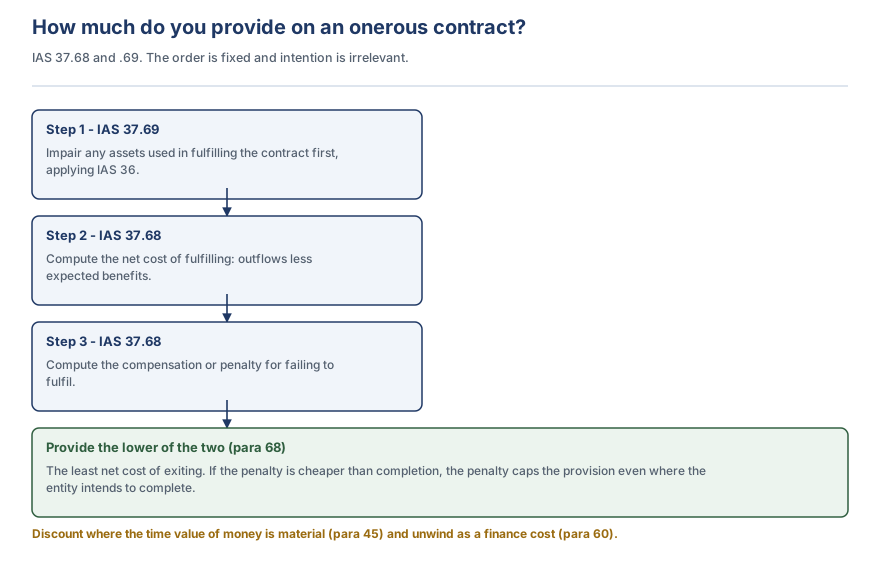
The cheaper of finishing the job and paying to get out of it. That is the "least net cost of exiting". If the penalty to walk away is less than the loss on completion, the penalty caps your provision, even if you intend to complete.
The unavoidable costs under a contract reflect the least net cost of exiting from the contract, which is the lower of the cost of fulfilling it and any compensation or penalties arising from failure to fulfil it.
Note what this does not say. It does not say the cost of the route you intend to take. It says the lower of the two. Intention is irrelevant to the measurement.
Compare the net cost of fulfilling with the compensation or penalty for failing to fulfil. Provide the lower. Impair dedicated assets first (unit 4).
Example 2: fulfil or pay the penalty
A manufacturer is committed to buy 10,000 components at GBP 12 each, GBP 120,000 total. The finished goods will now realise net proceeds of only GBP 100,000. The contract carries a cancellation penalty of GBP 15,000.
| Route | Working | Cost |
|---|---|---|
| Cost of fulfilling | 120,000 outflow less 100,000 benefit | 20,000 |
| Cost of exiting | Contractual penalty | 15,000 |
| Provision (para 68) | Lower of the two | 15,000 |
| Dr | Cr | |
|---|---|---|
| Onerous contract expense | 15,000 | |
| Provision for onerous contract | 15,000 |
The company may well decide to complete and absorb the GBP 20,000. The provision is still GBP 15,000, because that is the least net cost of exiting.
Local FAQs
What if there is no exit penalty at all? Then the only route is fulfilment, and the provision is the net cost of fulfilling. Where exit is free, revisit para 67: there may be no obligation.
Potential risks
The intended route measured instead of the cheaper one. Overstates the provision where the penalty is lower, understates it where fulfilment is.
Discounting skipped on a long contract. Common on multi-year outsourcing and supply agreements.
What counts as the cost of fulfilling the contract?
Both the incremental costs and a share of the other costs that relate directly to fulfilling contracts. The 2020 amendment settled this. Before it, some entities counted only incremental costs and therefore under-provided.
The cost of fulfilling a contract comprises the costs that relate directly to the contract. Costs that relate directly to a contract consist of both the incremental costs of fulfilling that contract, for example direct labour and materials, and an allocation of other costs that relate directly to fulfilling contracts, for example an allocation of the depreciation charge for an item of property, plant and equipment used in fulfilling that contract among others.
The amendment Onerous Contracts, Cost of Fulfilling a Contract applies to annual reporting periods beginning on or after 1 January 2022.
Example 3: the same contract, before and after the amendment
A services contract will generate GBP 900,000 of revenue and require:
| Cost | Amount | Incremental only | Directly related (para 68A) |
|---|---|---|---|
| Direct labour on the contract | 700,000 | Included | Included |
| Materials consumed | 150,000 | Included | Included |
| Depreciation of equipment used on this and other contracts | 120,000 | Excluded | Included, allocated |
| Head office overhead not related to fulfilling contracts | 80,000 | Excluded | Excluded |
| Cost of fulfilling | 850,000 | 970,000 | |
| Onerous? | No, 50,000 margin | Yes, 70,000 loss |
The same contract is profitable on the old reading and onerous on the current one. Any model built before 2022 needs re-running.
Real company: Rolls-Royce, 2024
Rolls-Royce reported net onerous provision charges of £55m for 2024, against £25m in 2023. Inside that movement, £382m of additional charges were largely associated with prolonged supply chain problems and were booked across onerous provisions and contract catch-ups.
Its Civil Aerospace long-term service agreements are warranty and service type contracts accounted for under IFRS 15 and IAS 37 together, so engine flying hour revenue and the cost of shop visits sit inside the same onerous assessment.
This is para 68A in a working business. Nobody changed a contract term. Supplier prices rose, so the incremental cost of fulfilling rose, the allocated share of other directly related costs rose with it, and contracts that were merely thin became onerous.
Rolls-Royce Holdings plc, 2024 Full Year Results. Figures as reported.Where firms differ: which costs go into a provision at all
IAS 37.68A tells you what goes into the cost of fulfilling a contract. It says nothing about what goes into any other provision, and that gap is filled differently by different preparers. KPMG states it plainly: IAS 37 provides no specific guidance on which costs to include in measuring a provision, so companies' approaches vary depending on the nature of the provision and their own accounting policy.
The result is two answers inside one balance sheet. An onerous contract provision picks up incremental costs plus an allocation of other directly related costs, because para 68A requires it. A legal claim provision in the same accounts is often measured on incremental costs only, the external lawyers and the payment to the claimant, with no allocation of the in-house legal team that will spend two years on the case.
The IASB has proposed to close the gap. Under ED/2024/8 every provision would be measured at all direct costs on the same basis, which would push some provisions up.
My view: the para 68A basis is the only defensible one for onerous contracts today. If your legal, warranty and restructuring provisions are measured on a narrower basis, say so in the accounting policy note. A reader is otherwise entitled to assume one measurement basis runs through the whole provisions note, and it usually does not.
KPMG IFRG Limited, Provisions: major accounting changes on the horizon, 2024. IASB Exposure Draft ED/2024/8 Provisions: Targeted Improvements, November 2024.Local FAQs
Does head office overhead go in? Only if it relates directly to fulfilling contracts. General administrative overhead that would be incurred regardless does not.
Is this the same as the IFRS 15 cost of fulfilling a contract? Related but not identical. IFRS 15.95 governs capitalising fulfilment costs as an asset. IAS 37.68A defines the cost used in the onerous test. Check IFRS 15 first for construction and long-term contracts, because an expected loss there is dealt with under IFRS 15 rather than IAS 37.
Potential risks
Incremental costs only. The pre-2022 practice. It systematically understates the provision and can turn an onerous contract into a profitable one on paper.
Everything allocated in. The opposite error. The test is costs that relate directly to fulfilling contracts, not a full absorption of overhead.
Do you impair the assets first?
Yes, and the order is not optional. Any impairment on the assets used in fulfilling the contract is recognised before the onerous provision is measured. Get the order wrong and you double count part of the loss.
Before a separate provision for an onerous contract is established, an entity recognises any impairment loss that has occurred on assets used in fulfilling the contract, applying IAS 36.
Example 4: order matters, with the numbers
A contract has 500,000 of revenue left to earn. Fulfilling it will cost 480,000 in cash, and it also consumes dedicated machinery with a carrying amount of 300,000 and no alternative use. The machinery's recoverable amount under IAS 36 is 120,000.
| Step | Working | Amount |
|---|---|---|
| 1. Impair first (para 69) | 300,000 carrying amount less 120,000 recoverable | Impairment 180,000 |
| 2. Cost of fulfilling, after the write-down | 480,000 cash costs plus 120,000 remaining depreciation | 600,000 |
| 3. Onerous provision | 600,000 cost of fulfilling less 500,000 benefit | Provision 100,000 |
| Total charge | 180,000 impairment plus 100,000 provision | 280,000 |
Now do it in the wrong order. Measure the provision first, using the full 300,000 of depreciation, and the cost of fulfilling is 780,000, so the provision is 280,000. Then impair the machinery by another 180,000. Total charge 460,000 against a real loss of 280,000, and 180,000 of it counted twice.
The total is the same when the order is right. What changes is the split, and a reader treats an impairment and a provision as different things: one is about an asset that is worth less, the other is about a liability you have taken on.
Local FAQs
What if the asset is used on several contracts? Then it is not fully dedicated and IAS 36 is applied at the cash-generating unit level. Only the depreciation allocated to this contract enters the para 68A fulfilment cost.
Does the impairment reduce the provision? Indirectly. Writing the asset down removes future depreciation from the cost of fulfilling, so the measured loss on the contract is smaller.
Potential risks
Provision first, impairment second. Double counts the loss and misstates two lines.
Impairment skipped entirely. Leaves an asset carried above its recoverable amount while a provision sits alongside it for the same economics.
Is a loss-making lease an onerous contract?
No, not under IAS 37. Leases sit in IFRS 16 and IAS 37 excludes them. A surplus or loss-making lease is dealt with by impairing the right-of-use asset under IAS 36, not by raising an onerous contract provision.
Where another Standard deals with a specific type of provision, contingent liability or contingent asset, an entity applies that Standard instead of this one. IFRS 16 deals with leases.
A lessee recognises a right-of-use asset. If the leased property becomes surplus or the lease uneconomic, the asset is tested for impairment under IAS 36 and written down to its recoverable amount. There is no onerous lease provision under current IFRS. Under the old IAS 17 there was, which is why the term survives in conversation.
Example 5: the same surplus office, two eras
| Framework | Treatment |
|---|---|
| IAS 17 (superseded) | Onerous lease provision for the remaining rentals net of any sublease income |
| IFRS 16 (current) | No provision. Impair the right-of-use asset under IAS 36. Any sublease income affects the recoverable amount |
Presenting the IAS 17 answer today would put a provision on the balance sheet that the current framework does not permit, and would leave the right-of-use asset overstated.
Local FAQs
What about the non-lease service element of a property contract? Service charges and dilapidations obligations sit outside the lease liability. A dilapidations obligation is an IAS 37 provision, covered in the dilapidations spoke.
Short-term and low-value leases where the exemption is taken? No right-of-use asset exists to impair. In that narrow case an onerous contract analysis under IAS 37 can be appropriate, because IFRS 16 is not measuring the obligation.
Potential risks
An onerous lease provision raised under IFRS 16. Superseded treatment. It creates a liability the framework does not recognise and hides an unimpaired asset.
The exempt-lease exception missed. Where the short-term or low-value exemption was taken, there is no asset to impair and the IAS 37 route may be the right one.
What are the journal entries for an onerous contract?
One entry on recognition, then reassessment every reporting date, then release as the contract is performed. The provision is used only for the loss it was set up for.
Recognise and measure as a provision (para 66) at the least net cost of exiting (para 68). Review at each reporting date and adjust to the current best estimate (para 59). Use the provision only for the expenditure for which it was originally recognised (para 61).
Example 6: full lifecycle
Onerous provision of GBP 15,000 recognised at 31 December 20X1 on the component contract from unit 2.
| Event | Dr | Cr | Amount |
|---|---|---|---|
| 31 Dec 20X1, recognise | Onerous contract expense | Provision | 15,000 |
| During 20X2, loss incurred as the contract is performed | Provision | Cost of sales / payables | 11,000 |
| 31 Dec 20X2, reassess remaining loss at 3,000 | Provision | Onerous contract expense (release) | 1,000 |
| Contract completed | Provision | Cost of sales | 3,000 |
The GBP 1,000 release is a change in estimate under para 59, shown separately in the para 84 reconciliation as an unused amount reversed. It is not netted into amounts used.
Local FAQs
Where does the expense sit in profit or loss? IAS 37 does not prescribe a line. In practice it follows the nature of the contract, usually cost of sales for a supply or service contract. Be consistent and disclose the policy.
Can the provision be used for other contract costs? No. Para 61 restricts it to the expenditure for which it was originally recognised. Using it for an unrelated cost conceals two events.
Potential risks
Release netted into amounts used. Hides estimate quality and breaches para 84.
Provision left in place after the contract completes. Para 59 requires reversal once no obligation remains.
What do people get wrong most often?
- A provision on a contract cancellable without penalty (para 67).
- Measuring the intended route rather than the lower of fulfilling and exiting (para 68).
- Incremental costs only, ignoring the 2020 amendment (para 68A).
- Provision before impairment (para 69).
- An onerous lease provision under IFRS 16 (IAS 37.5).
- An expected loss on a construction contract taken through IAS 37 instead of IFRS 15.
- No discounting on a multi-year contract (para 45).
- Release netted into amounts used (para 84).
What should you remember from this page?
- Onerous means unavoidable costs exceed expected benefits (para 10), not merely loss-making.
- Cancellable for nothing means no obligation (para 67).
- Provide the lower of fulfilling and exiting, regardless of intention (para 68).
- Cost of fulfilling includes an allocation of directly related costs, not just incremental (para 68A, effective 2022).
- Impair the assets used in fulfilling the contract first (para 69).
- Leases are IFRS 16 and IAS 36, not IAS 37 (para 5).
Frequently asked questions
What makes a contract onerous under IAS 37?
A contract is onerous when the unavoidable costs of meeting the obligations under it exceed the economic benefits expected to be received (IAS 37.10). Where the contract can be cancelled without compensation, IAS 37.67 says there is no obligation at all, so nothing is recognised.
How much do you provide on an onerous contract?
The least net cost of exiting, which IAS 37.68 defines as the lower of the cost of fulfilling the contract and any compensation or penalty for failing to fulfil it. This is not the route the entity intends to take; intention is irrelevant to the measurement.
What counts as the cost of fulfilling a contract?
Both the incremental costs, such as direct labour and materials, and an allocation of other costs that relate directly to fulfilling contracts, such as depreciation of equipment used on that contract among others (IAS 37.68A). The 2020 amendment applies to periods beginning on or after 1 January 2022.
Do you impair the assets before recognising an onerous contract provision?
Yes. IAS 37.69 requires any impairment loss on assets used in fulfilling the contract to be recognised under IAS 36 before a separate onerous contract provision is established. Providing first double counts part of the loss.
Is a loss-making lease an onerous contract?
No. IAS 37.5 gives way to IFRS 16 for leases, so a surplus or uneconomic lease is dealt with by impairing the right-of-use asset under IAS 36. There is no onerous lease provision under current IFRS; that was the superseded IAS 17 treatment.
What are the journal entries for an onerous contract?
Debit an onerous contract expense and credit a provision at the least net cost of exiting. As the loss is incurred it is charged against the provision (IAS 37.61), the provision is reassessed each reporting date (IAS 37.59), and any release is shown separately as an unused amount reversed in the para 84 reconciliation.
Do you discount an onerous contract provision?
Yes, where the effect of the time value of money is material (IAS 37.45). The annual increase is recognised as a finance cost under IAS 37.60, not as an operating expense.
About UQ Consulting
UQ Consulting is an independent technical reference for accounting and audit practitioners, covering IFRS, UK GAAP and US GAAP. Every technical assertion on this site carries a paragraph reference to the standard, and only currently effective guidance is presented as the accounting treatment; superseded standards appear as history or comparison only.
Written and reviewed by Usman Qureshi (ACCA), a Chartered Certified Accountant with a Big 4 audit and advisory background, and founder of UQ Consulting.
Disclaimer. Educational content, not professional advice. Provision recognition and measurement require significant judgement. Paragraph references are to IAS 37 as in force at the date of review. Company figures are drawn from the cited filings. Consult a qualified accountant for your circumstances.