What is a contingent liability?
A contingent liability is a possible obligation you do not put on the balance sheet. Either it might not exist at all until some future event settles the question, or it does exist but you cannot say an outflow is probable, or you cannot measure it reliably. In every one of those cases the answer is the same: disclose it, do not recognise it.
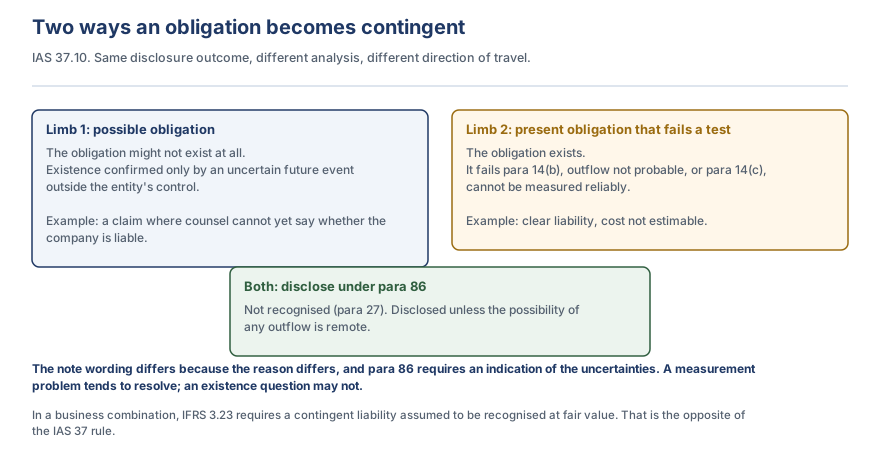
The standard gives two limbs. A contingent liability is either a possible obligation that arises from past events and whose existence will be confirmed only by the occurrence or non-occurrence of one or more uncertain future events not wholly within the control of the entity; or a present obligation that arises from past events but is not recognised because it is not probable that an outflow of resources embodying economic benefits will be required to settle the obligation, or the amount of the obligation cannot be measured with sufficient reliability.
Read that slowly, because the two limbs are different animals. The first is an obligation that might not exist. The second is an obligation that does exist but fails the recognition tests. Both get the same treatment, which is why they sit in one definition, but the analysis you write in the file is not the same.
An entity shall not recognise a contingent liability. Flat prohibition, no exceptions inside IAS 37. The one carve-out sits outside this standard: in a business combination, IFRS 3.23 requires the acquirer to recognise a contingent liability assumed if it is a present obligation and its fair value can be measured reliably, even though IAS 37 would not. That is a genuine inconsistency between two standards and it catches people on acquisition accounting.
Where an entity is jointly and severally liable for an obligation, the part of the obligation expected to be met by other parties is treated as a contingent liability. So a joint venture guarantee splits: your share is a provision if it meets para 14, and the share you expect the other party to cover is a contingent liability you disclose.
Example 1: three items, one definition, three different reasons
| Situation | Which limb | Why it is contingent |
|---|---|---|
| Customer has issued a claim; counsel cannot yet say whether the company is liable at all | Limb 1, possible obligation | Existence depends on the court, which is outside the company's control |
| Company is clearly liable for an environmental clean-up but the cost cannot be estimated within any useful range | Limb 2, present obligation failing measurement | The obligation exists; para 14(c) fails |
| Company has guaranteed a subsidiary's bank loan; the subsidiary is trading profitably and default is possible but not likely | Limb 2, present obligation failing probability | The obligation exists; para 14(b) fails at 50% |
All three are disclosed under para 86. None goes on the balance sheet. But the note wording differs in each case, because the reason differs, and para 86 requires an indication of the uncertainties.
Real company: bp, 2024: uncertainty inside a provision is not a contingency
bp discloses that the energy transition may bring forward the decommissioning of oil and gas assets and so increase the present value of the associated provisions, and that the majority of its existing upstream properties are expected to start decommissioning within the next two decades.
That uncertainty is not presented as a contingent liability, and it should not be. The obligation is not in doubt and the outflow is not merely possible, so it sits inside a recognised provision and the uncertainty is handled through measurement and estimation disclosure.
This is the distinction most often blurred in practice. Uncertainty about how much and when belongs inside a provision under paras 36 to 47. Uncertainty about whether an obligation exists at all is what makes something contingent.
bp p.l.c. Annual Report and Form 20-F 2024, decommissioning provisions. Figures as reported.Local FAQs
Is a contingent liability a liability? Only in the loose sense. In limb 1 there may be no obligation at all, so it is not a liability in the framework sense. In limb 2 there is a real present obligation, so it is a liability that simply fails the recognition tests. The label covers both, which is why the term causes so much confusion.
Does "contingent" mean unlikely? No. It means conditional or unconfirmed. A contingent liability can be quite likely to crystallise and still be contingent, if the amount cannot be measured reliably. Likelihood decides recognition; contingency describes the status.
Potential risks
The two limbs conflated in the file. A memo that says "possible obligation, therefore disclose" when the obligation plainly exists and the real failure is measurement has documented the wrong conclusion. The disclosure may look identical, but the next reporting date the analysis moves in a different direction: a measurement problem tends to resolve, an existence question may not.
The IFRS 3 exception missed. On an acquisition, contingent liabilities assumed are recognised at fair value if reliably measurable, which is the opposite of the IAS 37 rule. Applying IAS 37 to acquisition accounting understates the liabilities assumed and overstates goodwill.
What are the types of contingent liability, with examples?
The common ones are litigation, guarantees given, warranties beyond the normal population, tax disputes, environmental claims where liability is contested, and obligations under indemnities in a sale agreement. What unites them is that something outside your control decides the answer.
The standard does not list types. It sets a definition and a disclosure requirement, and practice has settled into recognisable categories. The categories matter because the evidence you need differs by type: a legal claim needs counsel's view, a guarantee needs the borrower's financial position, a tax dispute needs the authority's correspondence and precedent.
Example 2: the six categories you will actually meet
| Type | Typical trigger | What decides it | Where it usually lands |
|---|---|---|---|
| Litigation | Claim filed against the company | The court, or a settlement | Contingent until liability is probable, then a provision |
| Guarantees given | Parent guarantees a subsidiary's or third party's borrowing | The borrower defaulting | Contingent while the borrower performs. See unit 5 for the IFRS 9 overlay |
| Tax disputes | Authority challenges a filed position | The authority, tribunal or court | Contingent while contested. Note that uncertain tax positions go to IFRIC 23, not IAS 37 |
| Environmental claims | Contamination alleged but liability contested | Regulator, court, or the science | Contingent while liability is genuinely disputed |
| Sale and purchase indemnities | Warranties given on disposal of a business | A buyer claim within the warranty period | Contingent until a claim is made and becomes probable |
| Product recalls not yet announced | Defect identified, decision not taken | Whether the company announces | Nothing at all until announcement creates a constructive obligation (para 17) |
The last row is the one people get wrong. Before announcement there is often no obligation at all, so it is not even a contingent liability. It is nothing, and disclosing it as contingent overstates the position.
Local FAQs
Are uncertain tax positions contingent liabilities? No, and this is a common misfile. IFRIC 23 Uncertainty over Income Tax Treatments governs uncertain income tax positions, and it works through IAS 12, not IAS 37. IAS 37 still applies to non-income taxes such as levies, duties and payroll taxes in dispute.
Is a contingent liability the same as an off balance sheet item? Overlapping but not identical. A contingent liability is off balance sheet by definition, but plenty of off balance sheet exposures are not contingent liabilities: operating commitments, purchase commitments and undrawn facilities each have their own disclosure homes.
Potential risks
Everything disclosed as contingent to be safe. Over-disclosure is not free. Para 86 requires an estimate of the financial effect where practicable, so a long list of contingencies with no estimates reads as either lazy or evasive, and it dilutes the disclosure that actually matters.
Nothing disclosed because it is "remote". The remote exemption in para 86 is genuine but it is a conclusion, not an assumption. A file that reaches "remote" with no supporting evidence has skipped the work.
How do you account for a contingent liability?
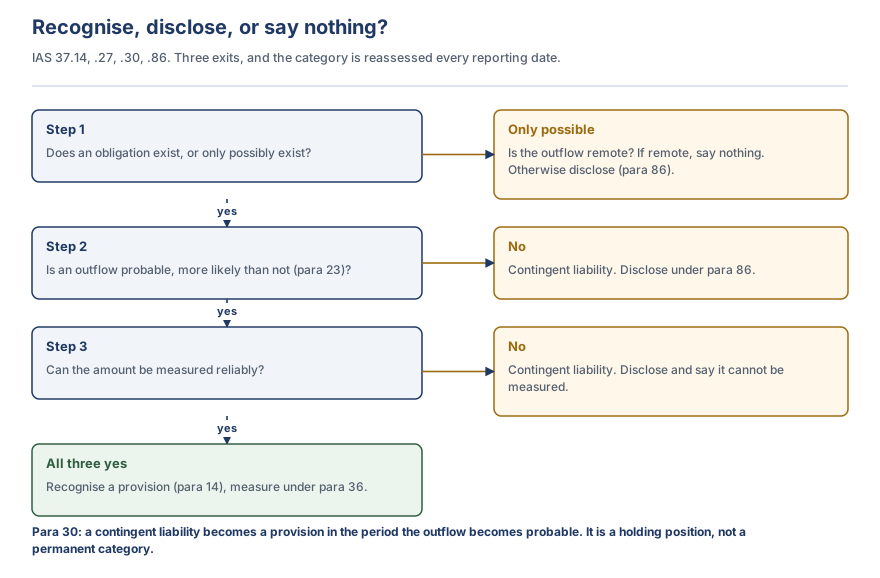
You do not. There is no journal entry. You write a note. The only accounting question is whether the item has stopped being contingent and become a provision, and that assessment is made again at every reporting date.
An entity shall not recognise a contingent liability. There is no debit and no credit. This sounds obvious and it is still the most common misunderstanding in the topic, because "accounting for contingent liabilities" is a phrase people search for expecting a journal.
Unless the possibility of any outflow in settlement is remote, an entity shall disclose for each class of contingent liability at the end of the reporting period a brief description of the nature of the contingent liability and, where practicable, an estimate of its financial effect, an indication of the uncertainties relating to the amount or timing of any outflow, and the possibility of any reimbursement.
Contingent liabilities are assessed continually to determine whether an outflow of resources has become probable. If it becomes probable that an outflow will be required for an item previously dealt with as a contingent liability, a provision is recognised in the financial statements of the period in which the change in probability occurs, except in the extremely rare circumstances where no reliable estimate can be made.
That last paragraph is the whole accounting model. A contingent liability is not a permanent category. It is a holding position, reviewed every period, and it converts to a provision the moment the probability crosses 50%.
Four decisions. Does an obligation exist, or only possibly exist? If it only possibly exists, is an outflow remote? If it exists, is an outflow probable? If probable, can it be measured reliably? The three exits are: recognise a provision, disclose a contingent liability, say nothing.
Example 3: the same guarantee at three reporting dates
A parent guarantees a GBP 5m bank facility drawn by an associate.
| Date | Facts | Assessment | Treatment |
|---|---|---|---|
| Year 1 | Associate trading well, covenants met | Present obligation exists under the guarantee, outflow not probable | Contingent liability, disclose (para 86) |
| Year 2 | Associate loses its main customer, breaches a covenant, lender has not yet called | Outflow now more likely than not | Provision recognised at the best estimate (para 30, then para 36) |
| Year 3 | Associate refinances, guarantee released | No obligation remains | Provision reversed (para 59) |
No entry in year 1. A charge in year 2. A credit in year 3. The item moved twice without anything being restated, because each move is a change in estimate, not an error.
Local FAQs
What is the journal entry for a contingent liability? There is none. Para 27 prohibits recognition. If you have found yourself writing a journal, the item is no longer contingent and you should be applying para 14 instead.
When does a contingent liability become a provision? When an outflow becomes probable, meaning more likely than not (para 30 read with para 23). Recognise it in the period the probability changes, not retrospectively.
Potential risks
A provision booked and left as a contingent disclosure as well. Double counting in the note. The reconciliation in para 84 and the contingency note in para 86 should not describe the same obligation.
A contingent liability that never moves. An item disclosed unchanged for five years is usually either a provision nobody wants to book or an exposure that has gone away. Para 30 requires continual assessment, so a static note is a finding.
Where do contingent liabilities appear in the financial statements?
In the notes, never on the face. There is no line on the balance sheet, nothing in profit or loss, and nothing in the cash flow statement. The only place a reader will find them is the contingencies note, which is why the quality of that note is the whole disclosure.
Disclosure is required for each class of contingent liability unless the possibility of any outflow is remote, covering the nature, an estimate of the financial effect where practicable, an indication of the uncertainties about amount or timing, and the possibility of any reimbursement.
Where a provision and a contingent liability arise from the same set of circumstances, an entity makes the disclosures required by paragraphs 84 to 86 in a way that shows the link between the provision and the contingent liability. This is the paragraph that stops a company recognising the comfortable part of an exposure and burying the uncomfortable part in a separate note twenty pages away.
In extremely rare cases, disclosure of some or all of the information can be expected to prejudice seriously the position of the entity in a dispute. In those cases the entity need not disclose the information, but shall disclose the general nature of the dispute, together with the fact that, and the reason why, the information has not been disclosed.
Example 4: what a compliant note contains
For a disputed tax assessment of GBP 12m where the company believes it will succeed:
| Para 86 requirement | What the note must say |
|---|---|
| Nature | The authority has assessed additional tax on the treatment of intra-group financing for the years 20X1 to 20X3 |
| Estimate of financial effect | GBP 12m, plus interest of approximately GBP 2m if the assessment is upheld |
| Uncertainties | The matter is at first-tier tribunal; a hearing is listed for 20X8; the outcome depends on the application of case law that is currently under appeal in a separate matter |
| Possibility of reimbursement | None, or state the indemnity if one exists |
A note that says only "the group is subject to various tax assessments, the outcome of which cannot be determined" fails three of the four.
Real company: Volkswagen Group, 2024: one event, a provision and a contingency
A named filer's note shows every rule above at once: the recognise and disclose split, the para 88 link where a provision and a contingency arise from the same circumstances, and the para 92 exemption used properly.
Volkswagen's 2024 contingent liabilities note discloses EUR 4.0 billion of contingent liabilities in connection with the diesel issue, of which EUR 3.8 billion relates to investor lawsuits in Germany. Separately, around EUR 0.6 billion is included in provisions for litigation and legal risks at 31 December 2024 for the currently known legal risks on the same matter.
That split is the whole of this page in one note. One underlying event produces a recognised provision of EUR 0.6bn for the parts where an outflow is probable and measurable under para 14, and a disclosed contingent liability of EUR 4.0bn for the parts that fail those tests. Para 88 requires the link between the two to be visible, and it is.
Volkswagen Group Annual Report 2024, notes to the consolidated financial statements, contingent liabilities and litigation. Figures as disclosed.Local FAQs
Do contingent liabilities go in the balance sheet? No. Never on the face. Para 27 prohibits recognition, so there is no balance to present. They appear only in the notes under para 86.
Do they affect any ratios? Not directly, because they are not recognised. But analysts and lenders adjust for them. A large disclosed guarantee will be included in a credit assessment even though it is not in reported net debt, which is precisely why the disclosure exists.
Potential risks
Boilerplate. "Various claims arise in the ordinary course of business" satisfies none of the four para 86 elements. It is the single most common contingency disclosure and it is non-compliant.
Para 92 used as a shield. The exemption says extremely rare. Applying it to a portfolio of ordinary litigation is a misreading, and even when it applies you must still disclose the general nature and the reason for withholding.
Are bank guarantees contingent liabilities?
Sometimes, and less often than people assume. A guarantee you have given is a contingent liability only if it is outside IFRS 9. Most financial guarantee contracts are inside IFRS 9, which means they are recognised and measured, not disclosed. Getting this wrong keeps a real liability off the balance sheet.
IAS 37 does not apply to financial instruments within the scope of IFRS 9. A financial guarantee contract, defined in IFRS 9 Appendix A as a contract that requires the issuer to make specified payments to reimburse the holder for a loss it incurs because a specified debtor fails to make payment when due, is within IFRS 9. It is recognised initially at fair value and subsequently at the higher of the loss allowance determined under the expected credit loss model and the amount initially recognised less cumulative income recognised.
So the guarantee you gave your subsidiary's bank is not a note. It is a recognised liability, and it carries an ECL measurement.
Where a guarantee falls outside IFRS 9, IAS 37 applies and the item is a contingent liability while an outflow is not probable. Performance guarantees, which pay out on failure to perform rather than failure to pay, are the usual example, because they do not meet the IFRS 9 definition of reimbursing a credit loss.
Example 5: two guarantees, two standards
| Guarantee | Pays out on | Standard | Treatment |
|---|---|---|---|
| Parent guarantees a subsidiary's GBP 5m bank loan | The subsidiary failing to repay the bank | IFRS 9 financial guarantee contract | Recognise at fair value on day one, then the higher of ECL and the unamortised initial amount |
| Contractor guarantees completion of a construction project by a fixed date | Failure to complete on time, not failure to pay | IAS 37 | Contingent liability while delay is not probable; provision once it is |
Same word, different standard, opposite balance sheet outcome. The test is not the label on the document, it is whether the trigger is a debtor's failure to pay.
Local FAQs
Our guarantee is to a group company, does that change it? Not for the standard applied. In the parent's separate financial statements an intragroup financial guarantee is still within IFRS 9 and still recognised. It eliminates on consolidation, which is why it is often missed in the separate statements.
What about letters of comfort? It depends entirely on the wording. A legally binding undertaking to make funds available can be a financial guarantee or a provision. A non-binding statement of intent is usually neither, though it can create a constructive obligation under para 10 if it has raised a valid expectation.
Potential risks
Financial guarantees disclosed rather than recognised. The most consequential error in this unit. An IFRS 9 guarantee treated as an IAS 37 contingency keeps a real liability off the balance sheet entirely, and skips the ECL measurement with it.
Intragroup guarantees ignored in separate financial statements. They eliminate on consolidation, so group reporting teams stop thinking about them. The parent's own accounts still need them.
What is a contingent asset, and why can you never recognise one?
A contingent asset is a possible asset whose existence depends on something outside your control, usually a claim you have brought. You never recognise it, because recognising it would mean booking income that may never arrive. The standard is deliberately harsher on the asset side than the liability side.
A contingent asset is a possible asset that arises from past events and whose existence will be confirmed only by the occurrence or non-occurrence of one or more uncertain future events not wholly within the control of the entity.
An entity shall not recognise a contingent asset. Contingent assets usually arise from unplanned or other unexpected events that give rise to the possibility of an inflow of economic benefits to the entity, for example a claim that an entity is pursuing through legal processes where the outcome is uncertain.
Contingent assets are not recognised in financial statements since this may result in the recognition of income that may never be realised. However, when the realisation of income is virtually certain, then the related asset is not a contingent asset and its recognition is appropriate.
That last sentence contains the whole mechanism. The asset does not become recognisable because the threshold has been met. It stops being contingent, and then ordinary recognition applies.
Example 6: the same claim, three stages
The company is suing a supplier for GBP 3m over a defective component.
| Stage | Likelihood of inflow | Contingent asset? | Treatment |
|---|---|---|---|
| Claim filed, defended | Possible | Yes | No disclosure. Below the para 89 threshold |
| Court finds for the company on liability, quantum to be assessed | Probable | Yes | Disclose under para 89: nature and estimate of financial effect |
| Judgment given for GBP 2.4m, defendant has paid into court and has no right of appeal | Virtually certain | No, it is now an asset | Recognise the receivable (para 33, 35) |
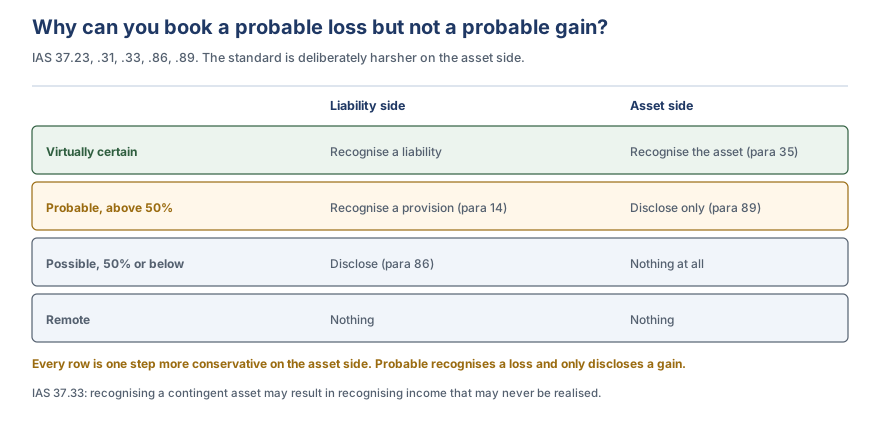
Note the asymmetry against unit 3. On the liability side, probable means recognise. On the asset side, probable means disclose only, and you need virtual certainty before anything hits the balance sheet.
Local FAQs
Why can I book a probable loss but not a probable gain? Prudence, written into the standard rather than left to judgement. IAS 37.33 says recognising a contingent asset may result in recognising income that may never be realised. The framework's neutrality principle bends here deliberately, and the IASB has kept it that way through successive reviews.
Is an insurance claim a contingent asset? Where it relates to a recognised provision, no. It is a reimbursement under para 53, recognised as a separate asset when receipt is virtually certain and capped at the provision. A claim unrelated to any provision is a contingent asset under para 31.
Potential risks
A litigation win accrued too early. Recognising the claim when counsel says you will probably win breaches para 31 and inflates both assets and income. It is also very visible when the case is later lost.
Netting the claim against the related provision. Prohibited on the balance sheet by para 53. Both sides are presented gross.
When do you disclose a contingent asset?
Only when an inflow is probable, which means more likely than not. Below that you say nothing at all. That is the opposite of the liability side, where disclosure is the default and silence is the exception.
Contingent assets are assessed continually to ensure that developments are appropriately reflected in the financial statements. Where an inflow of economic benefits is probable, an entity shall disclose a brief description of the nature of the contingent assets at the end of the reporting period and, where practicable, an estimate of their financial effect.
If it has become virtually certain that an inflow of economic benefits will arise, the asset and the related income are recognised in the financial statements of the period in which the change occurs.
The seriously prejudicial exemption applies to contingent assets as well as provisions and contingent liabilities. A company pursuing a claim rarely wants to publish its own estimate of what it will recover, and this is where that reluctance is accommodated.
Example 7: four positions on one scale
| Likelihood of inflow | Contingent liability equivalent | Contingent asset treatment |
|---|---|---|
| Virtually certain | Recognise a liability | Recognise the asset (para 35) |
| Probable, above 50% | Recognise a provision | Disclose only (para 89) |
| Possible, 50% or below | Disclose (para 86) | Nothing at all |
| Remote | Nothing | Nothing |
Every row is one step more conservative on the asset side. That single table answers most of the questions people ask about this topic.
Real company: Bayer, 2025 to 2026: why the insurance recovery is not the contingent asset you assume
Bayer disclosed provisions and liabilities for litigation of EUR 7.8 billion at 30 September 2025, of which EUR 6.5 billion related to glyphosate. Following settlement agreements reached in February 2026, including a proposed US nationwide class settlement, the reported figure rose to EUR 11.8 billion, of which EUR 9.6 billion related to glyphosate.
Two IAS 37 mechanics sit on top of each other here. Para 36 requires the best estimate at each reporting date and para 59 requires it to be revised as the picture changes. That is why a number can move by billions without the earlier figure having been wrong when it was made.
Bayer also states that it is insured against statutory product liability claims to the extent customary in its industries, but that the accounting measures relating to Roundup exceed the available insurance. Para 53 is why that sentence matters. A reimbursement is recognised as a separate asset only when recovery is virtually certain, it is capped at the amount of the provision, and it is never netted off.
Bayer AG, Annual Report 2024 and Quarterly Statement Q1 2026, legal risks disclosure. Figures as reported.Local FAQs
Can I disclose a contingent asset that is only possible? The standard does not require it and practice is against it, because disclosing a possible gain risks misleading readers about the likelihood of realisation. If a specific circumstance genuinely requires it for fair presentation, say plainly that realisation is not probable.
Does the disclosure need a number? An estimate of the financial effect is required where practicable (para 89). Where a claim's quantum is genuinely undetermined, say so and explain why, rather than omitting the disclosure.
Potential risks
Optimistic asset disclosure used to soften a bad result. A contingent asset note appearing in the same year as a large loss invites scrutiny of whether the probable threshold was genuinely met.
Disclosure retained after the claim fails. Para 34 requires continual assessment. A contingent asset note that survives a lost case is a stale disclosure.
How are contingent liabilities audited?
Mostly by looking for the ones management has not told you about. Completeness is the risk, not measurement. The core procedure is a legal confirmation letter to the entity's lawyers, and it is required by ISA 501, not optional.
The auditor shall design and perform audit procedures in order to identify litigation and claims involving the entity which may give rise to a risk of material misstatement, including inquiry of management and, where applicable, others within the entity including in-house legal counsel; reviewing minutes of meetings of those charged with governance and correspondence between the entity and its external legal counsel; and reviewing legal expense accounts.
If the auditor assesses a risk of material misstatement regarding litigation or claims that have been identified, or when audit procedures performed indicate that other material litigation or claims may exist, the auditor shall seek direct communication with the entity's external legal counsel through a letter of inquiry. If management refuses to give permission for the auditor to communicate with the entity's external legal counsel, or the legal counsel refuses to respond appropriately, and the auditor is unable to obtain sufficient appropriate audit evidence by performing alternative procedures, the auditor shall modify the opinion.
That is one of a small number of places in the ISAs where a specific refusal leads directly to a modified opinion. It is worth knowing, because management sometimes treats the lawyer's letter as a courtesy.
Where an obligation has crossed into a provision, the amount is an accounting estimate and ISA 540 applies: evaluate the method, assumptions and data, and perform a retrospective review of prior period provisions against outcomes to detect management bias.
Example 8: the procedures that actually find things
| Procedure | What it catches |
|---|---|
| Read board and committee minutes to the date of the report | Claims discussed but never passed to finance |
| Scrutinise the legal expense account | A dispute you were never told about, visible only as fees |
| Legal confirmation letter to external counsel | Counsel's own assessment, in their words, not management's summary |
| Review post year-end cash and correspondence | Settlements paid after the date that evidence a year-end condition |
| Inquire of operational management, not only finance | Product, regulatory and employment disputes that never reached the finance team |
The legal expense account is the highest-yield of these and the most often skipped. A dispute has to be paid for.
Local FAQs
Is a lawyer's letter always required? Not always. ISA 501.10 requires it where a risk of material misstatement regarding litigation or claims has been assessed, or where procedures indicate other material claims may exist. On a small entity with no litigation history and no legal expense, the earlier procedures may be enough. Document why.
What if counsel replies with boilerplate? A response that declines to give an assessment is not sufficient appropriate evidence. Go back, and if the position does not change, consider the ISA 501.11 consequences.
Potential risks
Management's summary accepted instead of counsel's own words. Counsel writes "we will defend this vigorously". Management translates that into "no provision required". Those are not the same statement and only one of them is evidence.
"We will defend vigorously" read as a probability. It is a litigation posture, not an assessment. Where a lawyer's letter avoids a likelihood, the file needs the entity's own reasoned conclusion against para 23.
How do contingent liabilities differ under US GAAP?
The framework is the same shape and the threshold is not. IAS 37 recognises at more likely than not; ASC 450 waits for "probable" in the US sense, which practice reads as a materially higher bar. On the same claim, IFRS books a provision and US GAAP writes a note.
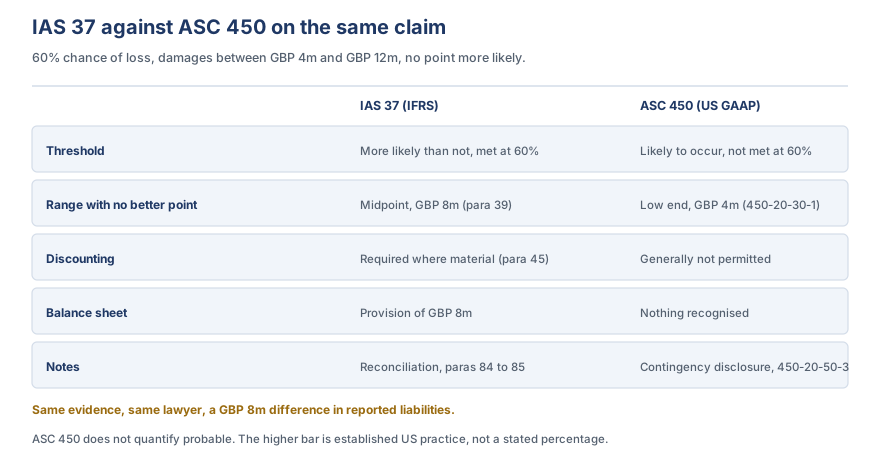
IAS 37.23 defines probable as more likely than not, greater than 50%. ASC 450-20-25-2 requires that it be probable that a liability had been incurred and that the amount be reasonably estimable. ASC 450 does not quantify probable, and US practice reads it as likely to occur, well above 50%.
Where the outcome is a continuous range of equally likely amounts, IAS 37.39 takes the midpoint. ASC 450-20-30-1 accrues the low end of the range and discloses the excess. On a GBP 4m to GBP 12m exposure that is GBP 8m against GBP 4m before you reach the recognition threshold at all.
Example 9: one lawsuit, two frameworks
Counsel assesses a 60% chance of losing, with damages between GBP 4m and GBP 12m and no point more likely than another.
| IAS 37 | ASC 450 | |
|---|---|---|
| Recognition threshold | More likely than not, met at 60% | Higher bar, likely not met at 60% |
| Measurement if recognised | Midpoint, GBP 8m, discounted if material | Low end, GBP 4m, generally undiscounted |
| Balance sheet | Provision of GBP 8m (before discounting) | Nothing recognised |
| Notes | Reconciliation and nature under paras 84 to 85 | Contingency disclosure under ASC 450-20-50-3 |
Same evidence, same lawyer, a GBP 8m difference in reported liabilities. Full treatment in the IAS 37 vs ASC 450 deep dive.
Local FAQs
Which framework is more conservative? Neither, consistently. IFRS recognises earlier, which is more conservative on the balance sheet. US GAAP measures at the low end of a range, which is less conservative when it does recognise. They pull in opposite directions.
Does US GAAP disclose contingencies not accrued? Yes. ASC 450-20-50-3 requires disclosure of at least reasonably possible losses, with the nature and an estimate of the possible loss or range, or a statement that an estimate cannot be made. So a US filer's note often carries exposures an IFRS filer would have already recognised.
Potential risks
A US-trained threshold applied in IFRS accounts. Systematic understatement of provisions, not a one-off error. Worth asking a group directly what threshold it believes it is applying.
A dual reporter running one assessment for both. The same claim genuinely produces different answers. One conclusion cannot serve both frameworks.
What do people get wrong most often?
- A financial guarantee disclosed instead of recognised. The most expensive error in this article. An IFRS 9 financial guarantee treated as an IAS 37 contingency keeps a real liability off the balance sheet and skips the ECL measurement. Unit 5.
- The two limbs of the definition conflated. "Possible obligation" written where the obligation plainly exists and the real failure is measurement. Same disclosure, wrong analysis, wrong direction of travel next period. Unit 1.
- A contingent asset recognised on a probable win. Para 31 prohibits it. You need virtual certainty, at which point it is no longer contingent. Unit 6.
- Boilerplate contingency notes. "Various claims arise in the ordinary course of business" satisfies none of the four para 86 elements. Unit 4.
- Uncertain tax positions filed under IAS 37. They belong to IFRIC 23 through IAS 12. Non-income taxes in dispute do stay in IAS 37. Unit 2.
- A US GAAP threshold applied to IFRS accounts. Systematic understatement, not a one-off. Unit 9.
- A static contingency note. Para 30 requires continual assessment. An item unchanged for years is either an unbooked provision or an exposure that has gone. Unit 3.
- Management's summary of counsel accepted as evidence. "We will defend vigorously" is a posture, not a probability. Unit 8.
What should you remember from this page?
- A contingent liability is never recognised (para 27). It is disclosed unless the possibility of outflow is remote (para 86).
- A contingent asset is never recognised (para 31). It is disclosed only if an inflow is probable (para 89), and recognised only once realisation is virtually certain, at which point it has stopped being contingent (para 33, 35).
- That asymmetry is deliberate prudence written into the standard, not a judgement call.
- Contingent liabilities convert to provisions the moment an outflow becomes probable (para 30). The category is a holding position, reassessed every period.
- Most bank guarantees are not contingent liabilities. Financial guarantee contracts sit in IFRS 9 and are recognised.
- Completeness is the audit risk. ISA 501 requires a legal confirmation letter where a risk of material misstatement has been assessed, and refusal of permission leads to a modified opinion.
- On the same 60% claim, IFRS recognises a provision at the midpoint of the range and US GAAP recognises nothing.
Frequently asked questions
What is a contingent liability?
A possible obligation whose existence depends on an uncertain future event outside the entity's control, or a present obligation that is not recognised because an outflow is not probable or the amount cannot be measured reliably (IAS 37.10). It is never recognised (IAS 37.27) and is disclosed under IAS 37.86 unless the possibility of any outflow is remote.
Where do contingent liabilities appear in the financial statements?
Only in the notes. There is no line on the balance sheet, nothing in profit or loss and nothing in the cash flow statement, because IAS 37.27 prohibits recognition. The disclosure sits in the contingencies note under IAS 37.86.
How do you account for a contingent liability?
You do not. There is no journal entry. The only accounting question is whether the item has stopped being contingent: IAS 37.30 requires a provision to be recognised in the period an outflow becomes probable.
What are the types of contingent liability?
Litigation, guarantees given, disputed non-income taxes, contested environmental claims, indemnities given on a disposal, and product recalls not yet announced. Uncertain income tax positions are not IAS 37; they fall under IFRIC 23 through IAS 12.
Are bank guarantees contingent liabilities?
Usually not. A financial guarantee contract, which pays out on a debtor's failure to pay, is within IFRS 9 and is recognised at fair value and then measured at the higher of the expected credit loss allowance and the unamortised initial amount. A performance guarantee, which pays out on failure to perform, falls under IAS 37 and can be a contingent liability.
Why can you never recognise a contingent asset?
Because it may result in recognising income that never arrives (IAS 37.33). A contingent asset is disclosed only where an inflow is probable (IAS 37.89), and is recognised only once realisation is virtually certain, at which point it has stopped being contingent (IAS 37.35).
What is the difference between a contingent liability and a contingent asset?
The thresholds. A probable outflow is recognised as a provision; a probable inflow is only disclosed. A contingent liability is disclosed unless remote; a contingent asset is disclosed only if probable. The asymmetry is deliberate prudence written into the standard.
How are contingent liabilities audited?
Completeness is the risk. ISA 501.9 requires inquiry of management and in-house counsel, review of minutes and correspondence, and review of legal expense accounts. Where a risk of material misstatement is assessed, ISA 501.10 requires a letter of inquiry to external counsel, and refusal of permission can lead to a modified opinion under ISA 501.11.
How do contingent liabilities differ under US GAAP?
ASC 450 uses a higher probable threshold than IAS 37's more likely than not, and accrues the low end of a range where IAS 37 takes the midpoint. On a 60 per cent claim of GBP 4m to GBP 12m, IFRS recognises GBP 8m and US GAAP recognises nothing.
About UQ Consulting
UQ Consulting is an independent technical reference for accounting and audit practitioners, covering IFRS, UK GAAP and US GAAP. Every technical assertion on this site carries a paragraph reference to the standard, and only currently effective guidance is presented as the accounting treatment; superseded standards appear as history or comparison only.
Written and reviewed by Usman Qureshi (ACCA), a Chartered Certified Accountant with a Big 4 audit and advisory background, and founder of UQ Consulting.
Disclaimer. Educational content, not professional advice. Provision recognition and measurement require significant judgement. Paragraph references are to IAS 37 as in force at the date of review. Company figures are drawn from the cited filings. Consult a qualified accountant for your circumstances.