What is a dilapidations provision, and when does the obligation arise?
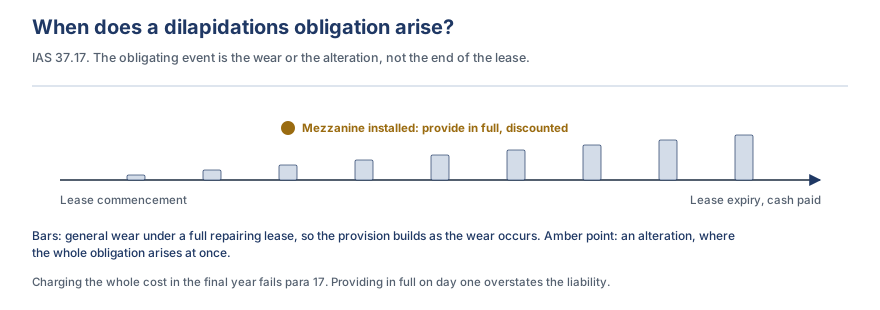
A dilapidations provision covers the cost of putting leased property back into the condition your lease requires when you hand it back. The obligation arises when the wear, alteration or damage happens, not when the lease ends and not when the landlord serves a schedule.
A provision is a liability of uncertain timing or amount, recognised where there is a present obligation from a past event, an outflow is probable, and a reliable estimate can be made.
The obligating event is the past event that leaves the entity no realistic alternative to settling. For dilapidations, that is the occupation and use of the property that creates the make-good obligation under the lease, or the alteration you carried out that must be reversed. It is not the expiry of the lease.
That distinction decides when the charge starts. A ten-year lease with a full repairing obligation builds a provision across the ten years as the wear occurs, not a single charge in year ten.
Example 1: two obligations, two start dates
| Situation | Obligating event | When the provision starts building |
|---|---|---|
| General wear and tear under a full repairing lease | Use of the property | Progressively, as the wear occurs |
| Removal of a mezzanine floor the tenant installed in year 3 | Installation of the mezzanine | In full at installation, discounted to present value |
Local FAQs
Do you provide from day one of the lease? Only for obligations that already exist. On day one, no wear has occurred and nothing has been altered, so there is usually nothing to provide. If the lease requires a specific reinstatement regardless of condition, that obligation may exist from the outset.
Is the landlord's schedule of dilapidations needed first? No. A schedule is evidence of the amount, not the trigger. Waiting for it defers a liability that already exists.
Potential risks
Charged in the final year. A large charge at lease exit for a decade of wear. It fails para 17 and moves cost between periods.
Provided in full on day one. Overstates the liability where no wear has yet occurred.
How do you measure a dilapidations provision?
Best estimate of what you would rationally pay to settle, discounted if the effect is material. Because you are estimating one property's condition years ahead, the estimate is judgemental and the discount rate matters.
The amount recognised shall be the best estimate of the expenditure required to settle the present obligation at the end of the reporting period, being the amount an entity would rationally pay to settle or transfer it.
A single property is a single obligation, so the most likely outcome is generally the best estimate (para 40), considered against other possible outcomes. A large portfolio of similar leases can be measured as a population at expected value (para 39).
Where the time value of money is material, measure at present value using a pre-tax rate reflecting current market assessments of the time value of money and the risks specific to the liability, without double counting risks already in the cash flows.
Example 2: a single lease, five years out
Surveyor's estimate of the make-good cost at lease end: GBP 240,000. Five years remaining. Pre-tax risk-adjusted rate 5%.
Present value = 240,000 / (1.05)^5 = 240,000 / 1.2763 = GBP 188,046
Recognise GBP 188,046 now for the wear that has already occurred, or the appropriate proportion of it, and unwind the discount each year (unit 3).
Local FAQs
Whose estimate do you use? A surveyor's schedule is the strongest evidence. Internal estimates are acceptable if supportable, but a material provision with no external input invites challenge.
Do you deduct expected landlord contributions? Only as a reimbursement asset under para 53, recognised separately when receipt is virtually certain and capped at the provision. Never netted on the balance sheet.
Potential risks
Expected value applied to one property. Para 40 wants the most likely outcome for a single obligation.
Risk double counted. A cautious cost estimate then discounted at a risk-loaded rate. Para 47 prohibits it.
What are the journal entries, and where does the unwind go?
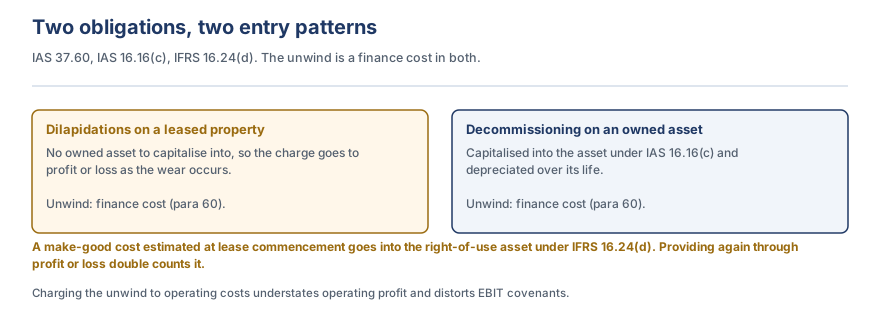
The charge usually goes to profit or loss over the lease, and the annual growth in the provision is a finance cost. On a decommissioning obligation capitalised into an asset, the pattern is different: the cost is capitalised and depreciated, and the unwind is still a finance cost.
Where discounting is used, the carrying amount of a provision increases in each period to reflect the passage of time. That increase is recognised as borrowing cost.
The cost of an item of property, plant and equipment includes the initial estimate of the costs of dismantling and removing the item and restoring the site, the obligation for which an entity incurs either when the item is acquired or as a consequence of having used the item during a particular period.
So a decommissioning obligation on your own asset is capitalised. A dilapidations obligation on a leased property is normally charged to profit or loss as the wear occurs, because there is no owned asset to capitalise it into. Under IFRS 16, a make-good cost that is an initial estimate at commencement is included in the right-of-use asset under IFRS 16.24(d).
Example 3: two obligations, two entry patterns
(a) Dilapidations accruing with wear, GBP 188,046 recognised
| Dr | Cr | |
|---|---|---|
| Dilapidations expense (operating) | 188,046 | |
| Provision | 188,046 | |
| Year 1 unwind at 5% | Finance cost 9,402 | Provision 9,402 |
(b) Decommissioning on an owned asset, 22,819,352 present value. This is the offshore platform from Example 7 of the IAS 37 pillar, carried through so the two pages agree: a restoration cost of 50,000,000 payable in 20 years, discounted at 4%.
| Dr | Cr | |
|---|---|---|
| PP&E, decommissioning component | 22,819,352 | |
| Provision | 22,819,352 | |
| Year 1 depreciation over 20 years | Depreciation 1,140,968 | Accumulated depreciation 1,140,968 |
| Year 1 unwind at 4% | Finance cost 912,774 | Provision 912,774 |
The two figures differ, and they should. Depreciation spreads the capitalised cost evenly across the life of the asset. The unwind grows the liability at the discount rate from a smaller opening base. They coincide only by accident, when the rate happens to equal one divided by the life, and a model that always shows them as equal is a model worth checking.
Local FAQs
Is the unwind an operating cost? No. Para 60 calls it borrowing cost. Charging it to operating expenses understates operating profit and distorts EBIT covenants.
What if the make-good cost was in the right-of-use asset at commencement? Then it is depreciated as part of that asset under IFRS 16.24(d), and only later changes go through the IAS 37 route.
Potential risks
Unwind in operating costs. Common and it moves real money between lines.
Double counting a make-good already in the right-of-use asset. Providing again through profit or loss charges the same obligation twice.
What happens when the estimate or the discount rate changes?
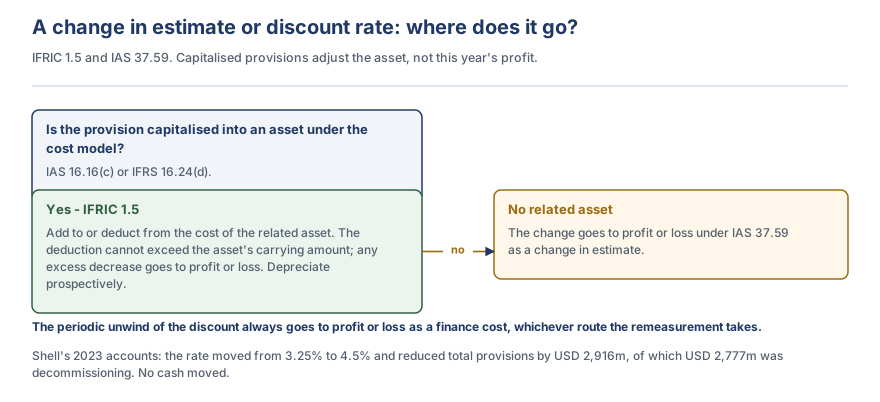
For a provision capitalised into an asset, the change adjusts the asset, not this year's profit. That is IFRIC 1, and it is why decommissioning provisions move materially in a year when nothing physical has changed.
Changes in the measurement of an existing decommissioning, restoration and similar liability that result from changes in the estimated timing or amount of the outflow, or a change in the discount rate, shall be accounted for as follows. If the related asset is measured using the cost model, changes in the liability shall be added to or deducted from the cost of the related asset in the current period, and the amount deducted shall not exceed the carrying amount of the asset. If a decrease in the liability exceeds the carrying amount, the excess is recognised immediately in profit or loss.
The revised asset is then depreciated prospectively over its remaining life. The periodic unwind of the discount always goes to profit or loss as a finance cost.
Is the provision capitalised into an asset under the cost model? If yes, adjust the asset, capped at its carrying amount, with any excess decrease to profit or loss, and depreciate prospectively. If there is no related asset, the change goes to profit or loss under IAS 37.59.
Example 4: a rate cut, no cash movement
At 31 December 20X4 the discount rate on a decommissioning provision falls from 5% to 4% and the cost estimate rises.
| Effect | Treatment |
|---|---|
| Provision increases | Added to the cost of the asset (IFRIC 1.5) |
| Asset carrying amount rises | Depreciated prospectively over the remaining 16 years |
| Current year profit | Unaffected, apart from the unwind |
Real company: Shell plc, 2023: a rate change worth USD 2.9bn
Shell's 2023 accounts show this at scale: the rate moved from 3.25% to 4.5% and reduced total provisions by USD 2,916 million, of which USD 2,777 million was decommissioning, with no cash changing hands.
No cash moved and no decommissioning work changed. One input moved and a provision measured in tens of billions moved with it. It is the plainest available demonstration of why the discount rate is the assumption tested hardest on a long-dated provision.
Shell plc Annual Report and Accounts 2023, consolidated financial statements, note on decommissioning and other provisions. Figures as disclosed.Where firms differ: the discount rate, and whether your own credit risk belongs in it
IAS 37.47 requires a pre-tax rate reflecting current market assessments of the time value of money and the risks specific to the liability. It does not tell you what that rate is, and it does not settle whether your own credit standing is one of the risks specific to the liability. KPMG describes current practice as mixed: some companies use a risk-free rate, others adjust it for non-performance or their own credit risk.
The difference is not cosmetic on a long-dated liability. On a provision settling in thirty years, a rate difference of a single percentage point moves the carrying amount by roughly a quarter.
ED/2024/8 would settle it in one direction: a risk-free rate, with no further adjustment for non-performance or own credit risk. KPMG's own observation on the consequence is worth reading twice. Provisions currently measured at risk-adjusted rates would get larger, and a distant decommissioning obligation that a company today regards as immaterial could become material enough to require recognition.
My view: if you are adjusting for own credit risk, treat that as a live exposure rather than a settled policy, and check now what the risk-free basis would do to your closing balance. A company that discovers the answer during the transition period has left itself no time.
KPMG IFRG Limited, Provisions: major accounting changes on the horizon, 2024, “Which rate to use in discounting a long-term provision”. IASB Exposure Draft ED/2024/8 Provisions: Targeted Improvements, November 2024.Real company: bp, 2024: the same rate story, and a second input people forget
bp raised the discount rate on its decommissioning provisions from 4.0% at 31 December 2023 to 4.5% at 31 December 2024, attributing the increase primarily to higher US treasury bond rates.
bp also discloses that the energy transition may bring forward the decommissioning of oil and gas assets and so increase the present value of the associated provisions, and that most of its existing upstream properties are expected to start decommissioning within the next two decades.
Put beside Shell, the first disclosure shows two large filers moving the same direction on rates for reasons entirely outside the asset. The second is the more useful one. Timing is an input just as cost is. A strategy decision that pulls decommissioning forward raises the provision immediately, with no change to the estimated cost of the work itself.
bp p.l.c. Annual Report and Form 20-F 2024, decommissioning provisions. Figures as reported.Local FAQs
Does a change in estimate on a dilapidations provision adjust an asset? Only if there is a related capitalised asset. For a leased property with the make-good charged to profit or loss, the change goes through profit or loss under IAS 37.59.
Is IFRIC 1 optional? No. Where the liability was capitalised under the cost model, IFRIC 1 prescribes the treatment.
Potential risks
Rate changes taken to profit or loss on a capitalised provision. Wrong under IFRIC 1 and it makes earnings swing on a market input.
The asset floor ignored. A decrease that exceeds the asset's carrying amount goes to profit or loss for the excess.
How does FRS 102 differ on dilapidations?
The recognition logic is the same shape but FRS 102 is shorter and the discounting requirement is expressed differently. It is worth checking, because most UK dilapidations questions come from FRS 102 preparers, not IFRS ones.
FRS 102 Section 21 Provisions and Contingencies requires a provision where there is a present obligation at the reporting date from a past event, it is probable that the entity will be required to transfer economic benefits in settlement, and the amount can be estimated reliably. A provision is measured at the best estimate of the amount required to settle the obligation, and where the effect of the time value of money is material, at the present value of the amounts expected to be required to settle it.
Section 21 also carries the same onerous contract requirement and the same prohibition on providing for future operating losses.
The FRC's Periodic Review 2024 amendments apply to periods beginning on or after 1 January 2026 and bring a new on-balance-sheet lease model into Section 20. That changes the surrounding lease accounting for a UK preparer, so a dilapidations obligation now sits alongside a right-of-use asset rather than an operating lease. Check which version of Section 20 applies before concluding.
Example 5: same lease, two frameworks
| Point | IAS 37 / IFRS 16 | FRS 102 Section 21 |
|---|---|---|
| Recognition trigger | Present obligation from a past event | Same |
| Measurement | Best estimate, discounted where material | Same in substance |
| Where the make-good sits at commencement | Right-of-use asset under IFRS 16.24(d) | Depends on which Section 20 applies from 2026 |
| Remeasurement on a rate change | IFRIC 1 where capitalised | No direct IFRIC 1 equivalent; follow Section 21 and Section 17 |
Local FAQs
Do small companies have to provide for dilapidations? Yes, if the recognition criteria are met. Section 1A reduces disclosure, not recognition and measurement.
Is there an FRS 102 equivalent of IFRIC 1? Not as a separate interpretation. Apply Section 21 with Section 17 for the asset consequence.
Potential risks
IFRS answers given to FRS 102 preparers. The recognition logic transfers; the lease and remeasurement mechanics may not.
The 2026 amendments overlooked. From 1 January 2026 the surrounding lease model changes and any pre-2026 guidance describes a superseded Section 20.
Can you use a rate per square foot?
As a starting point, yes. As the whole basis for a material provision, no. A benchmark rate is evidence, not an estimate, and IAS 37 wants the best estimate for this property in this condition.
The provision is the best estimate of the expenditure required to settle the obligation (para 36). Risks and uncertainties shall be taken into account (para 42), but uncertainty does not justify creating excessive provisions or deliberately overstating liabilities (para 43).
A market rate per square foot averages across condition, specification, location and the terms of individual leases. It is a reasonable cross-check and a reasonable basis for an immaterial portfolio. For a material single property it is weak evidence on its own.
Example 6: benchmark against survey
| Basis | Amount | Weight |
|---|---|---|
| Market benchmark, 12,000 sq ft at GBP 20 per sq ft | 240,000 | Cross-check |
| Surveyor's schedule for this property | 310,000 | Best estimate |
| Provision recognised | 310,000 | Para 36 |
Using the GBP 240,000 benchmark would understate by GBP 70,000 and the file would have no property-specific evidence behind a material number.
Real company: The Gambling Commission, 2024-25: a specific building, a named basis
The Gambling Commission's 2024-25 accounts disclose a dilapidations provision of GBP 1,329,000 for its Victoria Square House premises, stated as based on independent assessments carried out during 2024.
Two things there are worth copying. The provision is a figure for one building rather than a rate applied across an estate, and the basis of the estimate is named in the note. That is what para 85(b) asks for, and it is what a surveyor's report gives you that a rate per square foot cannot: an estimate tied to the actual condition of the actual property under the actual lease terms.
The Gambling Commission, Annual Report and Accounts 2024-25, provisions note. Figures as reported.Local FAQs
Is a benchmark acceptable for a large portfolio of similar units? Yes. A portfolio of similar obligations can be measured at expected value under para 39, and a calibrated rate per square foot is a legitimate way to build that.
How often should the estimate be refreshed? Every reporting date (para 59), and specifically where a lease break or expiry approaches, the property is altered, or a schedule is served.
Potential risks
A single benchmark rate on a material property. No property-specific evidence for a judgemental number.
A stale rate. Building cost inflation moves these materially and a rate set three years ago will be wrong.
What do people get wrong most often?
- Charging dilapidations in the final year of the lease (para 17).
- Providing in full on day one before any wear has occurred.
- Discount unwind charged to operating costs rather than finance costs (para 60).
- Rate and estimate changes taken to profit or loss on a capitalised provision (IFRIC 1.5).
- Double counting a make-good already inside the right-of-use asset (IFRS 16.24(d)).
- A landlord contribution netted against the provision (para 53).
- A single benchmark rate per square foot behind a material provision.
- IFRS mechanics applied to an FRS 102 preparer without checking Section 21 and which Section 20 applies.
What should you remember from this page?
- The obligating event is the wear or the alteration, not the lease ending (para 17).
- Discount where material and unwind as a finance cost (paras 45, 60).
- A decommissioning obligation on an owned asset is capitalised (IAS 16.16(c)); a make-good at lease commencement goes into the right-of-use asset (IFRS 16.24(d)).
- Changes in estimate or rate on a capitalised provision adjust the asset, not this year's profit (IFRIC 1.5).
- A rate per square foot is a cross-check, not an estimate.
Frequently asked questions
What is a dilapidations provision?
A provision for the cost of returning leased property to the condition the lease requires at the end of the term. It is an IAS 37 provision because the timing and amount are uncertain, and the obligating event is the wear, use or alteration that has already occurred (IAS 37.17).
When does a dilapidations obligation arise?
When the wear occurs or the alteration is made, not when the lease ends and not when the landlord serves a schedule of dilapidations. A schedule is evidence of the amount, not the trigger.
How do you measure a dilapidations provision?
At the best estimate of the expenditure required to settle (IAS 37.36), which for a single property is generally the most likely outcome considered against other possible outcomes (IAS 37.40), discounted at a pre-tax risk-adjusted rate where the effect of the time value of money is material (IAS 37.45, .47).
Where does the discount unwind go?
To finance costs. IAS 37.60 requires the increase in the carrying amount arising from the passage of time to be recognised as borrowing cost. Charging it to operating expenses understates operating profit.
What happens when the discount rate changes?
For a provision capitalised into an asset under the cost model, IFRIC 1.5 requires the change to be added to or deducted from the cost of the asset, capped at its carrying amount, and depreciated prospectively. Where there is no related asset, the change goes to profit or loss under IAS 37.59.
Is a decommissioning provision capitalised?
Yes, where it relates to an owned asset. IAS 16.16(c) includes the initial estimate of dismantling, removal and site restoration costs in the cost of the asset. A make-good cost estimated at lease commencement goes into the right-of-use asset under IFRS 16.24(d).
How does FRS 102 differ on dilapidations?
Section 21 requires a provision on the same recognition logic and measures at best estimate, discounted where material. There is no direct IFRIC 1 equivalent. Note also that the FRC Periodic Review 2024 brings a new on-balance-sheet lease model into Section 20 for periods beginning on or after 1 January 2026, which changes the surrounding lease accounting.
Can you use a rate per square foot?
As a cross-check, or as the basis for a calibrated portfolio estimate under IAS 37.39. For a material single property it is weak evidence on its own, because IAS 37.36 wants the best estimate for that property in its actual condition.
About UQ Consulting
UQ Consulting is an independent technical reference for accounting and audit practitioners, covering IFRS, UK GAAP and US GAAP. Every technical assertion on this site carries a paragraph reference to the standard, and only currently effective guidance is presented as the accounting treatment; superseded standards appear as history or comparison only.
Written and reviewed by Usman Qureshi (ACCA), a Chartered Certified Accountant with a Big 4 audit and advisory background, and founder of UQ Consulting.
Disclaimer. Educational content, not professional advice. Provision recognition and measurement require significant judgement. Paragraph references are to IAS 37 as in force at the date of review. Company figures are drawn from the cited filings. Consult a qualified accountant for your circumstances.