What must the provisions reconciliation show?
Six columns for every class of provision: the opening and the closing carrying amount, additional provisions including increases, amounts used, unused amounts reversed, and the increase from the passage of time and the effect of any change in the discount rate. Comparatives are not required, which is a genuine relief and frequently missed.
For each class of provision, an entity shall disclose the carrying amount at the beginning and end of the period; additional provisions made in the period, including increases to existing provisions; amounts used, that is incurred and charged against the provision, during the period; unused amounts reversed during the period; and the increase during the period in the discounted amount arising from the passage of time and the effect of any change in the discount rate. An entity need not provide comparative information.
Example 1: the reconciliation, built
| Warranty | Restructuring | Dilapidations | Total | |
|---|---|---|---|---|
| At 1 January | 1,500,000 | - | 188,046 | 1,688,046 |
| Additional provisions, including increases | 1,620,000 | 900,000 | 42,000 | 2,562,000 |
| Amounts used | (1,480,000) | (620,000) | - | (2,100,000) |
| Unused amounts reversed | (20,000) | - | - | (20,000) |
| Passage of time and change in discount rate | - | - | 9,402 | 9,402 |
| At 31 December | 1,620,000 | 280,000 | 239,448 | 2,139,448 |
Every line in para 84 has a column. The GBP 20,000 reversal is shown separately rather than netted into amounts used, because netting would hide the fact that the prior estimate was too high.
Real company: Rolls-Royce, 2024
Rolls-Royce's 2024 provisions disclosure shows why the reconciliation required by para 84 is the most useful table in the note. The net onerous provision charge for the year was £55m, against £25m in 2023. Separately, provisions produced a cash outflow of £170m, described as including outflows as the group traded through its onerous contract provisions.
A single closing balance would have told a reader almost nothing. The charge and the utilisation moved in different directions and for different reasons, and only the movement columns reveal that. This is exactly the point of para 84(b) and 84(c): additions and amounts used are separate facts, and netting them hides the story.
Rolls-Royce Holdings plc, 2024 Full Year Results. Figures as reported.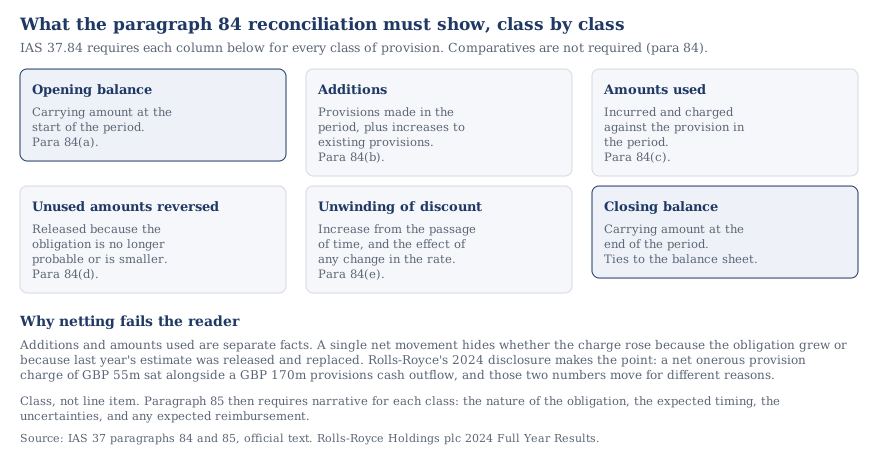
Local FAQs
What is a "class" of provision? Provisions of a similar nature, aggregated so the note is useful. Warranty, restructuring, legal and dilapidations are typical classes. Aggregating everything into "other provisions" defeats para 84.
Does the reconciliation have to be in the note, or can it sit in the front half? It is a note disclosure. Presenting the movement in a management commentary section and leaving the note with a single balance does not satisfy para 84, however visible the commentary is.
Potential risks
Reversals netted into amounts used. The most common fault in this note. It removes the only signal a reader has about estimate quality.
One "other provisions" class. Technically a reconciliation, practically useless, and it obscures each obligation's own movement.
What narrative must accompany each class of provision?
Three things: what the obligation is and when you expect to pay it, an indication of the uncertainties, and any expected reimbursement with the asset recognised for it.
An entity shall disclose, for each class of provision, a brief description of the nature of the obligation and the expected timing of any resulting outflows of economic benefits; an indication of the uncertainties about the amount or timing of those outflows, and where necessary to provide adequate information, the major assumptions made concerning future events as addressed in paragraph 48; and the amount of any expected reimbursement, stating the amount of any asset that has been recognised for that expected reimbursement.
Example 2: compliant against boilerplate
| Requirement | Boilerplate (fails) | Compliant |
|---|---|---|
| Nature and timing | "Provisions relate to various obligations." | "Warranty provisions cover 12-month manufacturer warranties on units sold in the year; substantially all claims are expected to be settled within 18 months of the reporting date." |
| Uncertainties | Omitted | "The provision is sensitive to the claims rate, which has ranged between 12% and 19% of units over the past five years; a one percentage point change would move the provision by approximately GBP 90,000." |
| Reimbursement | Omitted | "An asset of GBP 2.5m has been recognised for insurance reimbursement, being the amount virtually certain to be received." |
Real company: Bayer, 2025 to 2026: what a moving provision has to explain
Bayer's disclosed provisions and liabilities for litigation went from EUR 7.8 billion at 30 September 2025, including EUR 6.5 billion for glyphosate, to EUR 11.8 billion, including EUR 9.6 billion for glyphosate, after the February 2026 settlement agreements.
A movement of that size is where para 85 earns its place. The reconciliation shows the amount. Only the narrative explains that the change came from settlement agreements rather than from a deterioration in the underlying claims, and only the narrative can tell a reader that the insurance cover does not reach the exposure.
Bayer AG, Annual Report 2024 and Quarterly Statement Q1 2026, legal risks disclosure. Figures as reported.Local FAQs
Do you have to quantify the sensitivity? Para 85(b) requires an indication of the uncertainties, not a specified sensitivity. A quantified indication is the clearest way to satisfy it and it is what a reader can use.
When do the para 48 assumptions have to be disclosed? Where necessary to provide adequate information, for instance where the estimate depends on expected legislation or a technological change (para 48 to 50).
Potential risks
Generic uncertainty wording. A sentence that would apply to any provision at any company tells the reader nothing and fails para 85(b).
Reimbursement asset disclosed without the amount. Para 85(c) requires the amount of the asset recognised, not just the existence of cover.
What do you disclose about contingent liabilities and assets?
Contingent liabilities are disclosed unless remote. Contingent assets only when an inflow is probable. And where a provision and a contingency come from the same circumstances, the link between them has to be visible.
Unless the possibility of any outflow in settlement is remote, an entity shall disclose for each class of contingent liability a brief description of the nature and, where practicable, an estimate of its financial effect; an indication of the uncertainties relating to the amount or timing of any outflow; and the possibility of any reimbursement.
Where a provision and a contingent liability arise from the same set of circumstances, an entity makes the disclosures required by paragraphs 84 to 86 in a way that shows the link between the provision and the contingent liability.
Where an inflow of economic benefits is probable, an entity shall disclose a brief description of the nature of the contingent assets and, where practicable, an estimate of their financial effect.
Where any of the information required by paragraphs 86 and 89 is not disclosed because it is not practicable to do so, that fact shall be stated.
Real company: Volkswagen Group, 2024: one event, both disclosures, linked
Volkswagen's 2024 report discloses EUR 4.0 billion of contingent liabilities on the diesel issue, of which EUR 3.8 billion relates to investor lawsuits in Germany, alongside around EUR 0.6 billion within provisions for litigation and legal risks for the currently known legal risks on the same matter. One event, both disclosures, presented together as para 88 requires.
Presenting them together is not a style choice. Para 88 requires the link to be visible where a provision and a contingent liability arise from the same set of circumstances, and a reader who sees only one of the two numbers has seen half the exposure.
Volkswagen Group Annual Report 2024, contingent liabilities and provisions notes. Figures as reported.Local FAQs
What if you cannot estimate the financial effect? Para 91 requires you to say so. Silence is not permitted; an explicit statement that it is not practicable is.
Is "remote" a judgement you have to evidence? Yes. It is a conclusion that removes a disclosure, so the file needs support for it.
Potential risks
Provision and contingency in separate notes pages apart. Breaches para 88 and lets a reader miss half the exposure.
Silence where an estimate is impracticable. Para 91 requires the fact to be stated.
When can you withhold the detail?
Only in extremely rare cases where disclosing would seriously prejudice your position in a dispute. Even then you cannot go silent: you disclose the general nature of the dispute and the fact that, and reason why, information has been withheld.
In extremely rare cases, disclosure of some or all of the information required by paragraphs 84 to 89 can be expected to prejudice seriously the position of the entity in a dispute with other parties on the subject matter of the provision, contingent liability or contingent asset. In such cases, an entity need not disclose the information, but shall disclose the general nature of the dispute, together with the fact that, and reason why, the information has not been disclosed.
Example 3: what the exemption looks like when it is applied properly
Three elements have to be present together. The general nature of the dispute is disclosed, the quantification is withheld, and the reason for withholding it is given. Miss any one and the exemption has not been applied, it has been assumed. The Volkswagen wording quoted below is the clearest published example of all three in a single sentence.
Where firms differ: how far the seriously prejudicial exemption stretches
IAS 37.92 lets you withhold detail in extremely rare cases where disclosure would seriously prejudice your position in a dispute. It does not define seriously prejudice, does not say who decides, and gives no examples. Practice therefore runs the full range, from express reliance on the exemption across a whole category of litigation to no reliance on it at all.
Volkswagen sits at one end and says so, stating that in line with IAS 37.92 no further statements are made on estimates of financial impact or on uncertainty as to amount or maturity for additional important legal cases, so as not to compromise the proceedings or the interests of the company.
The pressure runs the other way in the United States, and it is worth reading even if you report under IFRS. KPMG records that the SEC staff has repeatedly said loss contingency disclosures are insufficient, and that general statements such as the outcome will not have a material adverse effect do not do the job. The staff accepts sensitivity around confidential or prejudicial information, but has said sufficient information must still be given for investors to evaluate the risk of loss, that confidentiality concerns can often be met by aggregating similar contingencies rather than by silence, and that an entity may give a range for some cases while stating it cannot estimate others.
My view: aggregation is the answer IAS 37 never spells out, and the one most preparers skip. If naming a single case would prejudice you, disclose the class. Reaching for para 92 across an entire litigation portfolio, on wording that repeats unchanged each year, is the version of this that does not survive a challenge.
KPMG LLP, ASC 450 loss contingencies guidance, 2025, reporting SEC staff observations on loss contingency disclosure. Volkswagen Group Annual Report 2024, contingent liabilities note. IAS 37.92.Local FAQs
How rare is extremely rare? Rare enough that invoking it across a portfolio of ordinary litigation is a misreading. It exists for the case where publishing your own reserve estimate would hand your opponent the number.
Does it cover contingent assets too? Yes. Para 92 covers provisions, contingent liabilities and contingent assets. A company pursuing a claim rarely wants to publish what it expects to recover.
Potential risks
Over-use. The standard says extremely rare. Wide use is a disclosure deficiency.
Total silence. The exemption permits withholding the detail, never the existence, the general nature or the reason.
What do people get wrong most often?
- Reversals netted into amounts used (para 84).
- A single "other provisions" class.
- Comparatives given as if required, or current-year lines omitted (para 84).
- Generic uncertainty wording (para 85(b)).
- Provision and related contingency disclosed apart (para 88).
- Silence instead of stating that an estimate is impracticable (para 91).
- Para 92 invoked across routine litigation.
What should you remember from this page?
- Six columns per class, and comparatives are not required (para 84).
- Nature, timing, uncertainties and reimbursement narrative for each class (para 85).
- Contingent liabilities unless remote; contingent assets only if probable (paras 86, 89).
- Link a provision to a contingency arising from the same circumstances (para 88).
- Say so where an estimate is impracticable (para 91).
- Para 92 withholds detail, never existence.
Frequently asked questions
What must the IAS 37 provisions reconciliation show?
Six columns for each class of provision: the opening and closing carrying amount, additional provisions including increases, amounts used, unused amounts reversed, and the increase from the passage of time and any change in the discount rate (IAS 37.84). Comparative information is not required.
Do you need comparatives for the provisions note?
No. IAS 37.84 expressly states that an entity need not provide comparative information for the reconciliation. Many preparers give them anyway, which is permitted but not required.
What narrative is required for each class of provision?
A brief description of the nature of the obligation and the expected timing of outflows, an indication of the uncertainties about amount or timing including major assumptions about future events where necessary, and the amount of any expected reimbursement stating the asset recognised for it (IAS 37.85).
What do you disclose about contingent liabilities?
Unless the possibility of any outflow is remote, the nature, an estimate of the financial effect where practicable, an indication of the uncertainties, and the possibility of any reimbursement (IAS 37.86).
What if you cannot estimate the financial effect?
IAS 37.91 requires the fact to be stated. Silence is not permitted where the information required by paragraphs 86 or 89 is omitted because it is not practicable to provide it.
When can you withhold provision disclosures?
Only in extremely rare cases where disclosure can be expected to prejudice seriously the entity's position in a dispute (IAS 37.92). Even then the general nature of the dispute, and the fact that and reason why information has been withheld, must still be disclosed.
About UQ Consulting
UQ Consulting is an independent technical reference for accounting and audit practitioners, covering IFRS, UK GAAP and US GAAP. Every technical assertion on this site carries a paragraph reference to the standard, and only currently effective guidance is presented as the accounting treatment; superseded standards appear as history or comparison only.
Written and reviewed by Usman Qureshi (ACCA), a Chartered Certified Accountant with a Big 4 audit and advisory background, and founder of UQ Consulting.
Disclaimer. Educational content, not professional advice. Provision recognition and measurement require significant judgement. Paragraph references are to IAS 37 as in force at the date of review. Company figures are drawn from the cited filings. Consult a qualified accountant for your circumstances.