What does over time vs point in time actually mean?
It is one question: when does the customer get control? If control passes gradually as you work, revenue is recognised over time. If it passes in a single moment, revenue is recognised at that moment. IFRS 15 runs a single assessment, in IFRS 15.35, and point in time is the residual outcome where none of the three criteria is met.
An entity shall recognise revenue when (or as) the entity satisfies a performance obligation by transferring a promised good or service (ie an asset) to a customer. An asset is transferred when (or as) the customer obtains control of that asset.
The bracketed "or as" is doing the heavy lifting. Everything else in this article is an elaboration of those two words.
Control of an asset refers to the ability to direct the use of, and obtain substantially all of the remaining benefits from, the asset. Control includes the ability to prevent other entities from directing the use of, and obtaining the benefits from, an asset.
Control is not risk and reward, which is where IAS 18 sat, and it is not physical possession, which is only one indicator among five. Files that still reason in risk-and-reward language are applying IAS 18 and IAS 11, both superseded for annual periods beginning on or after 1 January 2018.
For each performance obligation identified in accordance with paragraphs 22–30, an entity shall determine at contract inception whether it satisfies the performance obligation over time or satisfies the performance obligation at a point in time. If an entity does not satisfy a performance obligation over time, the performance obligation is satisfied at a point in time.
Three consequences that get missed in practice.
The assessment is per performance obligation, not per contract. A contract to supply equipment, install it, and service it for three years can easily carry one point in time obligation and two over time obligations. Concluding "this is an over time contract" is already an error of framing.
The assessment is made at contract inception. Not at the reporting date, and not when the outcome becomes clear. You lock the pattern in when you sign. Paragraph 36 confirms the alternative use assessment is made at inception and not updated for later changes, but a contract modification accounted for under IFRS 15.18 to 21 can create a new assessment, and so can the loss of an enforceable right to payment on renewal.
Point in time is the residual. Paragraph 32 is written so that failing the over time test lands you at a point in time automatically. There is no third answer and no judgement call about which feels more faithful. If a working paper reaches over time by asserting it rather than by naming which of the three criteria in paragraph 35 is met, it has not done the test.
The decision in sequence
| Step | Question | Where |
|---|---|---|
| 1 | Identify each performance obligation in the contract | IFRS 15.22–30 |
| 2 | For each one, is any of the three over time criteria met? | IFRS 15.35 |
| 3a | Yes: measure progress and recognise revenue as you perform | IFRS 15.39–45, B14–B19 |
| 3b | No: identify the date control transfers using the indicators | IFRS 15.38 |
Where this goes wrong in practice
The commonest failure is not a wrong answer, it is a missing one. A contract is described as long term, the entity has always used stage of completion, and the file records the outcome without ever naming the criterion. Asked which of paragraph 35(a), (b) or (c) is met, the working papers often have no answer at all.
That matters because the three criteria fail differently. If you were relying on 35(c), a change in the termination clause at renewal can flip the whole contract to point in time, and nobody will notice unless the original conclusion identified the criterion it depended on.
Local FAQs
Did IFRS 15 abolish percentage of completion? It abolished IAS 11 and the language, not the arithmetic. Cost-to-cost survives as an input method of measuring progress under IFRS 15.B18, but it is now a measurement technique applied after you have concluded the obligation is satisfied over time, not a contract type you elect into.
Can one performance obligation be part over time and part point in time? No. The unit of account carries a single pattern. If the economics really do split, that is a signal you have not disaggregated the performance obligations correctly under paragraphs 22 to 30.
Potential risks
Risk and reward reasoning. A conclusion built on who bears the risk of loss is applying superseded guidance. Control can pass while significant risk remains with the seller, and vice versa.
Contract-level conclusions. "This contract is recognised over time" is not a conclusion, because paragraph 32 operates at performance obligation level.
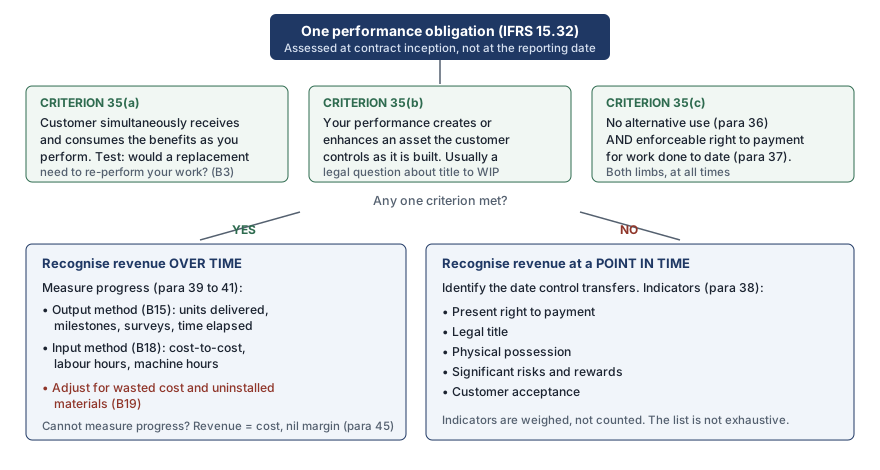
The three over-time criteria in IFRS 15.35
Meet any one of them and the obligation is satisfied over time. They are: the customer consumes as you perform, the customer controls the asset as it is built, or the asset has no alternative use to you and you have an enforceable right to payment for work done to date. Only one is needed, but you must be able to say which.
An entity transfers control of a good or service over time and, therefore, satisfies a performance obligation and recognises revenue over time, if one of the following criteria is met:
(a) the customer simultaneously receives and consumes the benefits provided by the entity's performance as the entity performs;
(b) the entity's performance creates or enhances an asset (for example, work in progress) that the customer controls as the asset is created or enhanced; or
(c) the entity's performance does not create an asset with an alternative use to the entity and the entity has an enforceable right to payment for performance completed to date.
Criterion (a): consumed as delivered
This is the routine services case. Cleaning, payroll processing, transaction processing, a hosted service the customer uses every day. Nothing accumulates that could be handed to someone else, because the benefit is used up at the moment it is produced.
For some types of performance obligations, the assessment of whether a customer receives the benefits of an entity's performance as the entity performs and simultaneously consumes those benefits as they are received will be straightforward. Examples include routine or recurring services, such as a cleaning service, in which the receipt and simultaneous consumption by the customer of the benefits of the entity's performance can be readily identified.
Para B4. For other types of performance obligations, an entity may not be able to readily identify whether a customer simultaneously receives and consumes the benefits from the entity's performance as the entity performs. In those circumstances, a performance obligation is satisfied over time if an entity determines that another entity would not need to substantially re-perform the work that the entity has completed to date if that other entity were to fulfil the remaining performance obligation to the customer. In making that determination, the entity assumes two things: it disregards any contractual restriction or practical limitation that would otherwise stop it transferring the remaining obligation to another entity, and it presumes the replacement would not have the benefit of any asset that is presently controlled by the entity and that would remain controlled by the entity if the obligation were transferred.
The re-performance test in B4 is the practical tool here, and it is applied less often than it should be. The question is whether a replacement, taking over the remaining work, would have to redo what has already been done. If not, criterion (a) is met.
A cleaning contractor: no, last month's cleaning stays done, so criterion (a) is met. A bespoke software build stopped at 60 per cent looks similar at first glance, because a replacement developer inherits the code. But B4 tells you to disregard any asset that would remain under your control, and the part-built code is exactly such an asset. Strip it away and the replacement does start again, so criterion (a) fails and the analysis moves to (b) or (c). That instruction in B4 is the reason partially completed goods and work in progress do not quietly qualify under (a).
Criterion (b): the customer controls the work in progress
The classic fact pattern is construction on land the customer already owns. The building attaches to the customer's land as it goes up, so under most legal systems the customer owns the partially built asset throughout. You are enhancing something that is already theirs.
The criterion turns on legal control of the work in progress, which is a legal question before it is an accounting one. Whether title to work in progress passes as construction proceeds is set by the contract and by local property law, and the answer differs by jurisdiction. This is one of the few places in IFRS 15 where a legal opinion is a reasonable thing to have on file.
Criterion (c): no alternative use plus an enforceable right to payment
This is the criterion that carries most of the difficult judgements, because both limbs must hold and each has its own definition.
An asset created by an entity's performance does not have an alternative use to an entity if the entity is either restricted contractually from readily directing the asset for another use during the creation or enhancement of that asset or limited practically from readily directing the asset in its completed state for another use.
The restriction has to be substantive. A contractual clause that the customer would never enforce, or one that only bites at the moment of delivery, is not enough. Practical limitation means significant economic loss on redirection, through rework, redesign or selling at a material discount.
Note the timing difference buried in that sentence. The contractual restriction is assessed during creation, while the practical limitation is assessed on the asset in its completed state. A mass-produced item that a customer has merely reserved is not restricted; a machine built to a customer's specification that would need to be stripped and rebuilt to sell elsewhere is practically limited.
An entity shall consider the terms of the contract, as well as any laws that apply to the contract, when evaluating whether it has an enforceable right to payment for performance completed to date in accordance with paragraph 35(c). The right to payment for performance completed to date does not need to be for a fixed amount. However, at all times throughout the duration of the contract, the entity must be entitled to an amount that at least compensates the entity for performance completed to date if the contract is terminated by the customer or another party for reasons other than the entity's failure to perform as promised.
Four traps sit inside that paragraph.
"At all times throughout the duration." The right must hold at every point, not on average and not at most milestones. A contract that compensates you at each quarterly milestone but leaves you exposed between milestones fails, because there is a moment when the right does not exist.
"At least compensates." Cost recovery alone is not enough. IFRS 15.B9 explains what that means: an amount that approximates the selling price of the goods or services transferred to date, for example recovery of costs incurred plus a reasonable profit margin. A termination clause that reimburses costs incurred and nothing else falls short.
Any laws that apply to the contract. The right can come from statute or established legal precedent rather than from the contract. Equally, a contractual right that local law would not enforce is not a right. Both directions require you to look outside the contract.
Termination for convenience. The reference to termination for reasons other than the entity's failure to perform is aimed squarely at the customer walking away because it feels like it. A deposit that is forfeited, or liquidated damages set at a fixed sum, will usually fall short of compensating for performance to date at some point in the contract.
Example 1: the same machine, three contracts
An engineering group builds specialised process equipment. On each unit the contract price is GBP 1,000,000 and cost incurred to date is GBP 600,000, so a termination payment of GBP 600,000 recovers cost and nothing more.
| Contract terms | Alternative use? | Right to payment? | Answer |
|---|---|---|---|
| Standard catalogue unit, customer may cancel with 30 days notice and forfeit a 10 per cent deposit | Yes, resaleable | No, deposit only | Point in time. Both limbs fail. A flat forfeitable deposit does not scale with performance, so it fails the B9/B10 test for a right to payment for performance completed to date |
| Built to customer specification; cancellation compensates costs incurred only, so GBP 600,000 today | No, redesign needed to resell | No. Cost recovered, no margin element | Point in time. B9 needs cost plus a reasonable margin |
| Built to customer specification; cancellation compensates costs incurred plus a reasonable margin at any date, so more than GBP 600,000 today | No | Yes | Over time under 35(c) |
The physical work is identical in all three rows. The revenue profile differs entirely, and it is set by the termination clause. This is why the commercial and legal teams drafting the contract are, in effect, choosing the revenue profile, usually without knowing it.
Real company: Emaar Properties, 2025 annual report: why off-plan property is not automatically over time
Emaar's revenue policy recites the paragraph 35 criteria in full, including the limb that its performance does not create an asset with an alternative use and that it has an enforceable right to payment for performance completed to date. But the 2025 financial statements are explicit that revenue is recognised "either at a point in time or over time depending on the terms of contracts with its customers and the relevant laws and regulations of the jurisdiction".
The qualifiers matter. A property developer selling units before completion does not get over time recognition because the sector conventionally reports that way. It gets it contract by contract, jurisdiction by jurisdiction, and the deciding factor is what the local law and the sale agreement do on termination. Where over time applies, Emaar's auditors describe progress being measured in proportion to costs incurred against total estimated costs.
The practical read-across: if you audit or prepare accounts for a developer operating across several jurisdictions, one group-wide conclusion is almost certainly wrong.
Emaar Properties PJSC, Integrated Annual Report 2025, revenue recognition policy and the auditor's key audit matter on revenue. Policy wording is the point here, so no balance is quoted.Local FAQs
Do I need to meet all three criteria? No. Paragraph 35 says "if one of the following criteria is met". Working through all three when the first is clearly satisfied is wasted effort, though naming the one you relied on is not.
Is a customer deposit an enforceable right to payment? Rarely. Early in a contract a deposit may exceed work done, but paragraph 37 requires the right at all times, and by the later stages the deposit will fall short.
Does a partially completed asset held on my premises fail criterion (b)? Possession is not control. What matters is whether the customer controls the work in progress in substance, which usually comes down to title and to whether they can direct its use.
Potential risks
The criterion is never named. Without it, the conclusion cannot be reassessed when contract terms change at renewal.
Cost recovery mistaken for compensation. The single most common misreading of paragraph 37, and it flips the answer to point in time.
Sector precedent used as the analysis. "Construction is always over time" and "product sales are always point in time" are both wrong often enough to matter.
Point in time: how do you identify the date control transfers?
You work through the five indicators in IFRS 15.38. They are indicators, not conditions, so no single one decides it and you are not counting how many are met. You are asking when the customer got the ability to direct the use of the asset and obtain substantially all its benefits.
If a performance obligation is not satisfied over time in accordance with paragraphs 35–37, an entity satisfies the performance obligation at a point in time. To determine the point in time at which a customer obtains control of a promised asset and the entity satisfies a performance obligation, an entity shall consider the requirements for control in paragraphs 31–34. In addition, an entity shall consider indicators of the transfer of control, which include, but are not limited to, the following:
(a) the entity has a present right to payment for the asset;
(b) the customer has legal title to the asset;
(c) the entity has transferred physical possession of the asset;
(d) the customer has the significant risks and rewards of ownership of the asset;
(e) the customer has accepted the asset.
Two words carry the weight: "include, but are not limited to". This is a non-exhaustive list of evidence, not a checklist and not a scoring exercise. A file that records "four of five indicators met, therefore control has transferred" has substituted arithmetic for judgement.
Note also that risks and rewards appears here, at (d), as one indicator of control. It survived into IFRS 15 in that reduced role. It is not the test.
The indicators that most often mislead
| Fact pattern | Indicator that misleads | Where control usually sits |
|---|---|---|
| Bill and hold: invoiced and title passed, goods still in your warehouse | (c) possession not transferred | Can still be with the customer, but only if the strict conditions in IFRS 15.B81 are met |
| Goods shipped on consignment to a distributor | (c) possession transferred | Usually still with you until the distributor sells on |
| Delivered subject to customer acceptance testing | (e) acceptance outstanding | With the customer already, where acceptance is an objective specification you can verify (IFRS 15.B84) |
| Retention of title clause until payment | (b) legal title retained | Usually with the customer; the clause is credit protection, not a control feature |
The pattern in that table is worth stating plainly. Legal form points one way and control points the other more often than most preparers expect, and in both directions. A retention of title clause almost never delays revenue. A shipment to a distributor who can return unsold stock almost always does.
Real company: Boeing, FY2025 Form 10-K: two revenue patterns inside one group
Boeing states that revenue for each commercial aircraft performance obligation is recognised at the point in time when the aircraft is completed and accepted by the customer. Its Defense, Space and Security segment is different: revenue there is generally recognised over the contract term as costs are incurred, on the basis that recognising revenue as costs are incurred provides an objective measure of progress. The revenue disaggregation shows the two segments running on essentially opposite patterns, with commercial aircraft revenue almost entirely at a point in time and defence revenue almost entirely over time.
Same group, same standard, opposite answers. The driver is contract terms, not product complexity, and it is worth noticing that a commercial airliner is not a less bespoke asset than a defence programme. What differs is the termination and payment architecture of a government contract against a commercial order book.
One nuance not to lose: Boeing's commercial trigger is completion and acceptance by the customer, not shipment, and its cost of sales still runs on programme accounting. The revenue pattern and the cost pattern are separate questions.
The Boeing Company, Form 10-K for the year ended 31 December 2025, summary of significant accounting policies and the revenue and segment information notes, filed with the SEC.Real company: Airbus and Barratt Redrow: point in time in two very different industries
Airbus states that revenue from the sale of commercial aircraft is recognised at a point in time, at delivery of the aircraft, while its military and space long-term contracts are recognised over time where there is no alternative use and an irrevocable right to payment.
Barratt Redrow recognises revenue on private housing at legal completion. Its policy states that for commercial and multi-unit contracts there is a single performance obligation for which revenue is recognised at a point in time, when construction has been completed and control is transferred. There is a narrow carve-out: the group recognises revenue over time on certain multi-unit contracts, but only where control of the associated land has transferred to the customer before or during construction.
That carve-out is criterion 35(b) doing exactly what it is designed to do. Once the land is the customer's, the group is enhancing an asset the customer already controls, and the pattern changes. A housebuilder and a contractor can put up an identical building and report revenue on completely different profiles, because one owns the land while it builds and the other does not.
Airbus SE, Financial Statements FY 2024, revenue recognition policy. Barratt Redrow plc, Annual Report and Accounts 2025 (year ended 29 June 2025), revenue recognition policy.Local FAQs
How many of the five indicators do I need? There is no threshold. They are evidence of control, weighed together against the definition in paragraph 33.
Is delivery the same as transfer of control? Often, but not by definition. Incoterms tell you when risk and cost pass, which is indicator (d), and that is one input to the assessment rather than the answer.
Does a customer acceptance clause always defer revenue? No. Where acceptance is a formality against objective criteria you can verify yourself, IFRS 15.B84 allows you to conclude control has transferred before the paperwork arrives. Where you cannot objectively determine conformity with the agreed specification, IFRS 15.B85 says control does not transfer until acceptance is given, which is the position on subjective satisfaction clauses and on-site trials.
Potential risks
Indicators counted rather than weighed. The standard says "include, but are not limited to" for a reason.
Cut-off driven by the invoice date. A present right to payment is one indicator, not the event.
Bill and hold conceded without the B81 conditions. Substantive reason, product separately identified as the customer's, ready for physical transfer, and not capable of being used for another customer. All four, or it is not a sale.
Measuring progress: output methods and input methods
Once an obligation is over time, you must pick a single method that depicts your performance in transferring control. Output methods measure what the customer has received; input methods measure what you have put in. Cost-to-cost is an input method, it is the most common, and it is the one that needs the most correction before it gives a faithful answer.
For each performance obligation satisfied over time, an entity shall recognise revenue over time by measuring the progress towards complete satisfaction of that performance obligation. The objective when measuring progress is to depict an entity's performance in transferring control of goods or services promised to a customer.
"Depict performance in transferring control" is the test any method has to pass. It is not "match costs to revenue" and it is not "produce a smooth margin". Where those two objectives conflict, paragraph 39 wins.
An entity shall apply a single method of measuring progress for each performance obligation satisfied over time and the entity shall apply that method consistently to similar performance obligations and in similar circumstances. At the end of each reporting period, an entity shall remeasure its progress towards complete satisfaction of a performance obligation satisfied over time.
Para 41. Appropriate methods of measuring progress include output methods and input methods.
Two obligations here that are routinely missed. A single method per obligation, so you cannot blend cost-to-cost with milestones on the same obligation because one gives a more comfortable result. And remeasurement every reporting date, which makes progress an estimate revisited continuously, accounted for prospectively as a change in estimate under IAS 8.
Output methods
Output methods recognise revenue on the basis of direct measurements of the value to the customer of the goods or services transferred to date relative to the remaining goods or services promised under the contract. Output methods include methods such as surveys of performance completed to date, appraisals of results achieved, milestones reached, time elapsed and units produced or units delivered.
Conceptually these are the better methods, because they measure the thing the standard cares about. The catch is in B15's own warning: they only work where the output you can observe faithfully represents your progress, and the information is often not available without undue cost.
Units delivered and units produced carry a specific trap. Where there is work in progress or finished goods controlled by the customer that the output measure does not capture, those methods ignore performance you have genuinely completed, and B15 says they would not faithfully depict it. Physical location on site is not the test; control is.
As a practical expedient, if an entity has a right to consideration from a customer in an amount that corresponds directly with the value to the customer of the entity's performance completed to date (for example, a service contract in which an entity bills a fixed amount for each hour of service provided), the entity may recognise revenue in the amount to which the entity has a right to invoice.
Underused, and a genuine simplification for time-and-materials and per-transaction contracts. The condition is that the invoiced amount corresponds directly with value delivered. A contract with a fixed monthly fee, an upfront mobilisation charge, tiered pricing or a back-end bonus does not qualify, because the invoicing pattern and the delivery pattern have come apart.
Input methods
Input methods recognise revenue on the basis of the entity's efforts or inputs to the satisfaction of a performance obligation relative to the total expected inputs to the satisfaction of that performance obligation. Input methods include methods such as resources consumed, labour hours expended, costs incurred, time elapsed or machine hours used. A shortcoming of input methods is that there may not be a direct relationship between an entity's inputs and the transfer of control of goods or services to a customer.
The standard names its own weakness. Cost-to-cost assumes spending is a proxy for progress, and that assumption breaks whenever cost is incurred without performance being transferred.
A shortcoming of input methods is that there may not be a direct relationship between an entity's inputs and the transfer of control of goods or services to a customer. Therefore, an entity shall exclude from an input method the effects of any inputs that, in accordance with the objective of measuring progress in paragraph 39, do not depict the entity's performance in transferring control of goods or services to the customer. For instance, when using a cost-based input method, an adjustment to the measure of progress may be required in the following circumstances:
(a) when a cost incurred does not contribute to an entity's progress in satisfying the performance obligation. For example, an entity would not recognise revenue on the basis of costs incurred that are attributable to significant inefficiencies in the entity's performance that were not reflected in the price of the contract, such as the costs of unexpected amounts of wasted materials, labour or other resources.
(b) when a cost incurred is not proportionate to the entity's progress in satisfying the performance obligation. In those circumstances, the best depiction of the entity's performance may be to adjust the input method to recognise revenue only to the extent of that cost incurred. That is a zero-margin outcome, and B19(b) applies it only where the good is not distinct, the customer obtains control of it significantly before receiving the related services, its cost is significant relative to the total expected costs, and the entity procures it from a third party and is not significantly involved in designing and manufacturing it.
Limb (a), wasted cost, is the one auditors chase and preparers resist, because excluding it turns an overrun into an immediate margin hit rather than a revenue catch-up. Limb (b), uninstalled materials, is the one everybody forgets. Deliver a GBP 4m third-party turbine to site on day one of a GBP 20m contract and a naive cost-to-cost calculation says you are 20 per cent done and books a fifth of the contract margin. Where the four conditions above hold, B19(b) says recognise revenue equal to the cost of that turbine and no margin, because procuring is not installing. Note the last condition: plant you designed and built yourself does not get this treatment, because manufacturing it was performance.
Example 2: cost-to-cost, before and after the B19 adjustments
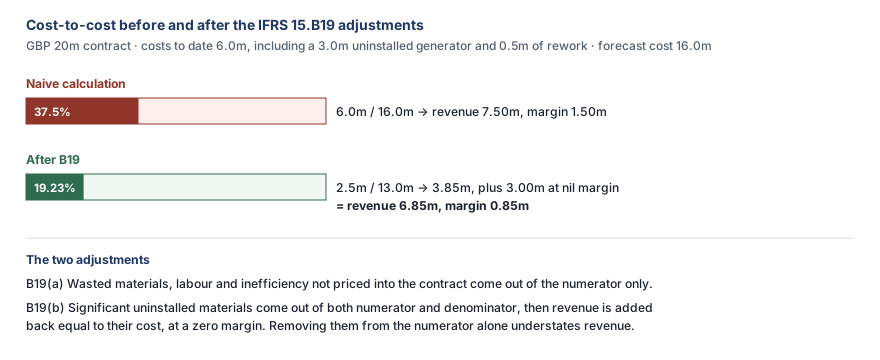
A contractor has a GBP 20,000,000 fixed-price contract, satisfied over time under criterion 35(b). Original total forecast cost GBP 16,000,000. At the reporting date, costs incurred are GBP 6,000,000, which include GBP 3,000,000 for a generator delivered to site but not yet installed, and GBP 500,000 of rework caused by the contractor's own defective workmanship, not recoverable from the customer.
| Measure | Naive calculation | After B19 |
|---|---|---|
| Costs incurred used in the ratio | 6,000,000 | 2,500,000 (6,000,000 less 3,000,000 uninstalled less 500,000 wasted) |
| Total forecast cost used in the ratio | 16,000,000 | 13,000,000 (16,000,000 less the 3,000,000 generator) |
| Measure of progress | 37.5% | 19.23% |
| Revenue on the ratio | 7,500,000 | 3,846,154 |
| Plus revenue on uninstalled generator, at cost, zero margin | – | 3,000,000 |
| Revenue recognised | 7,500,000 | 6,846,154 |
| Cost of sales | 6,000,000 | 6,000,000 |
| Margin to date | 1,500,000 | 846,154 |
The naive figure overstates revenue, and therefore margin, by GBP 653,846, on a contract where nothing has gone wrong commercially beyond GBP 500,000 of rework. Note the mechanics of the uninstalled adjustment: the generator comes out of both the numerator and the denominator, then is added back as revenue at cost. Removing it from the numerator alone is a common error and understates revenue. The rework is treated differently and comes out of the numerator only, because the GBP 500,000 was never in the original forecast; had the forecast been revised to GBP 16,500,000 to absorb it, the same amount would come out of both.
Real company: Balfour Beatty, 2024 annual report: the input method, stated plainly
Balfour Beatty's policy states that revenue from construction and services activities is recognised over time and that the group uses the input method to measure progress of delivery. The measurement note is more specific: contract revenue is recognised by reference to the measure of progress at the reporting date using the input method, costs are recognised as incurred, and revenue is recognised on the basis of the proportion of total costs at the reporting date to the estimated total costs of the contract.
Two details are worth lifting out. The same policy note records that revenue from the group's manufacturing activities is recognised at a point in time, so even inside a construction group the answer is set at performance obligation level rather than by sector. And the denominator is the estimated total cost, which makes every reported revenue figure a function of a forecast that management controls. That is the single most sensitive input in contract accounting and it is why cost forecasts are a standard key audit matter for contractors.
Balfour Beatty plc, Annual Report and Accounts 2024, accounting policies note, revenue recognition and construction contracts.Real company: ITT Inc. and Parker Hannifin: mixed methods across one portfolio
ITT discloses that for contracts recognised over time it uses the cost-to-cost method or the units-of-delivery method depending on the nature of the contract, including length of production time. Parker Hannifin discloses that where revenue is recognised over time it uses the cost-to-cost, efforts expended or units of delivery method depending on the nature of the contract.
Both disclosures do something IFRS 15.124 asks for and many policies quietly skip: naming the basis on which the method is selected, so that using different methods across a portfolio reads as consistent application rather than as inconsistency. Paragraph 40 is a measurement requirement, not a disclosure one, and it asks for a single method per obligation applied consistently to similar obligations in similar circumstances. Neither paragraph asks for one method across the whole group.
ITT Inc., Form 10-K for the year ended 31 December 2025; Parker-Hannifin Corporation, Form 10-K for the year ended 30 June 2025. Both filed with the SEC. These are ASC 606 filers, and the requirement is aligned with IFRS 15 on this point.Local FAQs
Which method should I choose? The one that best depicts transfer of control, judged against paragraph 39, not the one that is easiest to compute. In practice output methods win where an observable, verifiable output exists, such as units delivered or a surveyed measurement, and input methods win where the work is continuous and heterogeneous.
Can I change method during the contract? Not as a free choice. Paragraph 40 requires a single method per obligation, applied consistently, so switching because the alternative gives a more comfortable result is not permitted. Two things are different. Updating the measure of progress as circumstances change is required by IFRS 15.43 and is a change in estimate, recognised prospectively. Concluding that the method never depicted performance faithfully is a prior period error under IAS 8.
Do I include subcontractor costs in cost-to-cost? Yes, to the extent they represent performance delivered. Where you have prepaid a subcontractor who has not yet performed, that is B19(b) territory again: cost incurred not proportionate to progress.
Is time elapsed ever acceptable? Yes, and it is the right answer for a stand-ready obligation where the customer benefits evenly across the period, such as an unlimited-access support arrangement. Note that time elapsed appears in both B15 and B18. The label follows what it is measuring: elapsed contract term as a proxy for output, or elapsed effort as a proxy for input.
Potential risks
Uninstalled materials left in the ratio. Accelerates revenue and margin, and it is most severe early in a contract, which is exactly when the estimate is least reliable.
Rework and inefficiency treated as progress. Converts an overrun into revenue and masks a deteriorating contract.
The denominator not updated. A stale total-cost forecast is the quietest way to overstate progress, and it leaves no audit trail.
Method chosen for smoothing. If the reason for the method is that the alternative produces a lumpy margin, paragraph 39 has been inverted.
What if you cannot measure progress reliably?
You do not fall back to point in time. The obligation is still satisfied over time; you simply recognise revenue only to the extent of costs you expect to recover, at zero margin, until you can measure progress. This is a temporary state, not a policy.
An entity shall recognise revenue for a performance obligation satisfied over time only if the entity can reasonably measure its progress towards complete satisfaction of the performance obligation. An entity would not be able to reasonably measure its progress towards complete satisfaction of a performance obligation if it lacks reliable information that would be required to apply an appropriate method of measuring progress.
Para 45. In some circumstances (for example, in the early stages of a contract), an entity may not be able to reasonably measure the outcome of a performance obligation, but the entity expects to recover the costs incurred in satisfying the performance obligation. In those circumstances, the entity shall recognise revenue only to the extent of the costs incurred until such time that it can reasonably measure the outcome of the performance obligation.
The IAS 11 muscle memory here is to stop recognising revenue altogether. That is not what paragraph 45 says. Revenue equals cost, margin is nil, and the contract keeps moving.
Example 3: the first quarter of a complex contract
A systems integrator signs a GBP 8,000,000 contract satisfied over time under 35(c). Scope is still being finalised with the customer, so a reliable total cost forecast does not yet exist. Costs of GBP 900,000 are incurred in the first quarter and are expected to be recoverable.
| Dr | Cr | |
|---|---|---|
| Contract asset | 900,000 | |
| Revenue | 900,000 | |
| Cost of sales | 900,000 | |
| Cash / payables | 900,000 |
Nil margin, revenue recognised, contract asset created. Once the scope and cost forecast firm up in the following quarter, the entity moves to its chosen method and the catch-up runs through that period's revenue as a change in estimate.
Local FAQs
What if I do not expect to recover the costs? Then paragraph 45 does not apply, no revenue is recognised, and you are into onerous contract territory. IFRS 15 has no onerous contract provision of its own, so you test the contract under IAS 37.66 to 68A after first impairing any related contract asset under IFRS 9 and any capitalised contract costs under IFRS 15.101 to 104.
How long can zero-margin recognition run? As long as the outcome genuinely cannot be measured, which for most contracts is a matter of months, not years. A contract still at nil margin at its second year end is telling you either that the estimating process has failed or that the contract is loss-making and nobody has said so.
Potential risks
Revenue suspended entirely. The IAS 11 answer, and it understates revenue and inflates the following period.
Zero margin used to defer a known loss. If total costs are expected to exceed total revenue, that is an onerous contract now, not a measurement difficulty.
Construction, real estate, SaaS: the same test, different answers
None of these sectors has its own rule. What differs is which of the three criteria in paragraph 35 they typically land on, and therefore what breaks the conclusion when contract terms change.
| Sector and fact pattern | Usual answer | Criterion relied on | What flips it |
|---|---|---|---|
| Contractor building on the customer's land | Over time | 35(b): customer controls the work in progress | Local property law that does not pass title to work in progress |
| Developer selling completed units from its own stock | Point in time | None met | Nothing; this is the straightforward case |
| Developer selling off-plan units it is building on its own land | Either, and it is genuinely contentious | 35(c) if it applies at all | The termination clause and whether local law gives an enforceable right to payment with a margin |
| Housebuilder selling private homes | Point in time on legal completion | None met | Transferring the land to the customer before construction, which pulls it into 35(b) |
| SaaS subscription, hosted, no licence transferred | Over time | 35(a): consumed as delivered | Rarely anything; the harder questions are allocation and setup fees, not timing |
| On-premise software licence, right to use | Point in time | None met | Whether the licence is a right to access, which is over time under IFRS 15.B58 |
| Bespoke software developed for one customer | Usually over time | 35(c), sometimes 35(b) | A termination clause that compensates cost only, with no margin |
| Manufacturing to customer specification | Contested; often point in time | 35(c) if both limbs hold | Whether the unit could practically be redirected, and what termination pays |
| Long-term maintenance or stand-ready support | Over time | 35(a) | Nothing; the question is the method, and time elapsed usually wins |
Read down the "what flips it" column and a pattern emerges. Almost every over-time conclusion outside the pure services cases depends on either a property law question or a termination clause. Neither of those lives in the finance function. Both change at contract renewal. That is why the conclusion has to be documented with the criterion named, and why standard-form contract changes are a revenue recognition event that the finance team should be told about before signature rather than after.
The question that decides most of these cases
Before the accounting analysis, one question decides most of this: what happens if the customer terminates tomorrow for no reason? Everything in paragraph 35(c) is answered by that clause, and the answer is either in the contract, in the local law, or nowhere. If the file cannot answer it, the over-time conclusion is unsupported no matter how much analysis sits behind it.
The corollary is uncomfortable for group reporting. A multinational applying one revenue policy across jurisdictions with different termination law is applying a policy that cannot be right everywhere.
Local FAQs
Is SaaS revenue always recognised over time? The hosting service almost always is, because the customer consumes it as delivered. Implementation, data migration and training may be separate obligations with their own patterns, and a distinct on-premise licence element can be point in time.
Do construction contracts still use percentage of completion? The calculation survives as an input method under B18, but only after the over time conclusion is reached under paragraph 35. The order matters, and reversing it is the most common structural error in contract files.
Worked example: three years of journals under the input method
The mechanics matter as much as the conclusion. Over time recognition detaches revenue from invoicing, which is what creates contract assets and contract liabilities. Here is a full contract, including a cost overrun and an onerous position, from signature to completion.
A contractor signs a fixed-price contract for GBP 10,000,000, satisfied over time under criterion 35(b). Progress is measured cost-to-cost. Billing follows a payment schedule that does not track performance.
| Year | Costs incurred to date | Total forecast cost | Progress | Cumulative revenue | Revenue in year | Billed in year |
|---|---|---|---|---|---|---|
| 1 | 2,000,000 | 8,000,000 | 25.0% | 2,500,000 | 2,500,000 | 3,000,000 |
| 2 | 7,150,000 | 11,000,000 | 65.0% | 6,500,000 | 4,000,000 | 3,000,000 |
| 3 | 11,000,000 | 11,000,000 | 100% | 10,000,000 | 3,500,000 | 4,000,000 |
Year 1: revenue behind billing, so a contract liability
| Dr | Cr | |
|---|---|---|
| Cost of sales | 2,000,000 | |
| Cash / payables | 2,000,000 | |
| Receivables | 3,000,000 | |
| Revenue | 2,500,000 | |
| Contract liability | 500,000 |
Margin in year 1 is GBP 500,000. Billing has run ahead of performance by GBP 500,000, which is a contract liability under IFRS 15.106, not deferred income and not a payable.
Year 2: the forecast moves, and the whole contract re-prices
Total forecast cost rises from GBP 8,000,000 to GBP 11,000,000. Cumulative revenue becomes 65 per cent of GBP 10,000,000, so GBP 6,500,000, leaving GBP 4,000,000 for the year against costs of GBP 5,150,000.
| Dr | Cr | |
|---|---|---|
| Cost of sales | 5,150,000 | |
| Cash / payables | 5,150,000 | |
| Receivables | 3,000,000 | |
| Contract liability | 500,000 | |
| Contract asset | 500,000 | |
| Revenue | 4,000,000 |
A loss of GBP 1,150,000 in the year, and the position has swung from a contract liability to a contract asset of GBP 500,000. The mechanism is worth naming: the change in estimate is applied to the cumulative position, so the entire effect of the revised forecast lands in year 2 rather than being spread forward. This is a change in accounting estimate under IAS 8, recognised prospectively, and it is why a single revised cost forecast can wipe out a year's margin on a contract that is still physically on track.
Year 2 continued: the onerous contract provision
Total contract revenue is GBP 10,000,000 and total forecast cost is GBP 11,000,000, so the contract will lose GBP 1,000,000. Losses recognised so far are a profit of GBP 500,000 in year 1 and a loss of GBP 1,150,000 in year 2, a net loss of GBP 650,000. The remaining unavoidable loss of GBP 350,000 is provided now.
| Dr | Cr | |
|---|---|---|
| Cost of sales (onerous contract charge) | 350,000 | |
| Provision for onerous contract | 350,000 |
Year 2 therefore reports a loss of GBP 1,500,000, being the GBP 1,150,000 from the change in estimate and the GBP 350,000 provided for the future loss. Recognising the future loss now, rather than letting it emerge in year 3, is the whole purpose of IAS 37.66. Note the sequencing point again: the contract asset of GBP 500,000 is tested first, and only the residual loss is provided.
Year 3: completion
| Dr | Cr | |
|---|---|---|
| Cost of sales | 3,850,000 | |
| Cash / payables | 3,850,000 | |
| Receivables | 4,000,000 | |
| Contract asset | 500,000 | |
| Revenue | 3,500,000 |
Before the provision is released, year 3 shows revenue of GBP 3,500,000 against costs of GBP 3,850,000, a loss of GBP 350,000. That is precisely the loss provided for at the end of year 2, so the provision is released against it.
| Dr | Cr | |
|---|---|---|
| Provision for onerous contract | 350,000 | |
| Cost of sales | 350,000 |
Year 3 therefore reports a nil result. Cumulative revenue is GBP 10,000,000, cumulative cost GBP 11,000,000, cumulative loss GBP 1,000,000, recognised as a profit of GBP 500,000 in year 1 and a loss of GBP 1,500,000 in year 2. The contract asset unwinds to nil as the final billing catches up with performance.
Local FAQs
Is a contract asset the same as an accrued income or amounts recoverable on contracts? No. IFRS 15.107 requires a contract asset to be presented where the entity performs before the customer pays, and Appendix A defines it as a right to consideration that is conditional on something other than the passage of time, which is exactly why it is presented separately from a receivable. It also sits in the scope of the IFRS 9 expected credit loss model.
Should the year 2 catch-up be restated into year 1? No. A revised cost forecast is a change in estimate, recognised in the period of change. Restatement is only appropriate if year 1 was wrong on the information available then, which is an error.
Potential risks
Contract assets shown within trade receivables. Breaches IFRS 15.105 presentation and hides the conditionality from users, and from the ECL assessment.
The onerous provision recognised before impairment. IAS 37.69 sets the order and reversing it double counts.
The onerous test skipped once the contract turns. Recognising the loss only as it emerges, period by period, defers a loss that IAS 37.66 requires now.
Cost forecast revisions batched to year end. Paragraph 40 requires remeasurement at each reporting date, which includes interim reporting.
Review and audit: what actually gets challenged
The conclusion is rarely the weak point. The evidence behind it usually is, and it fails in a small number of predictable places: the named criterion, the termination clause, the cost forecast, and the two B19 adjustments.
The evidence a defensible file needs
| Assertion | What supports it | How it typically fails |
|---|---|---|
| The obligation is satisfied over time | The specific criterion named, with the contract clause or legal analysis it rests on | Conclusion stated without naming 35(a), (b) or (c) |
| An enforceable right to payment exists | The termination clause, and legal input where the right depends on local law | Cost recovery read as compensation; the "at all times" condition never tested |
| The asset has no alternative use | Evidence of contractual restriction or of the economic loss on redirection | Asserted from the fact that the product is customised |
| Progress is faithfully measured | Method selection rationale against paragraph 39; the B19 adjustments computed | Uninstalled materials and rework left in the ratio |
| The total cost forecast is reasonable | Forecast to actual on completed contracts; movement analysis on the current portfolio | Forecast accepted because it is management's; no retrospective accuracy testing |
On the cost forecast specifically, the most informative procedure is also the cheapest: take the last two or three completed contracts and compare the total cost forecast at each interim date against the eventual outturn. A pattern of forecasts that only rise as contracts progress tells you the estimating process is systematically optimistic, and that every open contract in the portfolio is carrying overstated progress today. It also gives you something better than a discussion of management bias in the abstract.
Disclosure, where the audit trail usually thins out
Paragraph 119 requires disclosure of information about the entity's performance obligations, including when the entity typically satisfies them, and paragraph 124 requires an entity to disclose the methods used to recognise revenue for performance obligations satisfied over time and an explanation of why the methods used faithfully depict the transfer of goods or services.
The second half of paragraph 124 is the part most policies omit. Stating that the group uses an input method based on costs incurred satisfies the first requirement. Explaining why that depicts transfer of control satisfies the second, and a boilerplate policy note that names the method without the explanation is technically incomplete.
Also worth remembering that the judgements described here almost always meet the IAS 1.122 threshold for judgements with a significant effect, and the cost forecast will usually meet IAS 1.125 for estimation uncertainty. For a contractor, those two disclosures are frequently more informative to a user than the revenue policy itself. For periods beginning on or after 1 January 2027, IAS 1 is replaced by IFRS 18, which carries these requirements forward with amendments to IAS 8 for material accounting policy information. The substance of what has to be disclosed about revenue judgements does not change.
Potential risks
Policy note describes the method but not why it is faithful. IFRS 15.124 asks for both.
Judgement disclosure silent on the criterion relied on. Users cannot assess sensitivity to a termination clause they are not told about.
No disaggregation between over time and point in time revenue. Where both patterns exist, this is usually a necessary disaggregation category under IFRS 15.114.
What have regulators actually found on this?
Two primary-source findings, one UK and one US, both current. The FRC flags a gap in how the over-time judgement itself is disclosed; the PCAOB flags a gap in how auditors test the output method once a firm has concluded revenue is over time.
UK FRC, 2019 thematic review: the judgement is made but not shown
The FRC's thematic review of first-year IFRS 15 disclosures found that "one company disclosed that judgement was applied in determining whether revenue was recognised over time or at a point in time but did not detail its evaluation of when the customer obtained control." On progress measurement, the review states: "We encourage companies that apply certain output methods such as 'milestones met' to carefully explain why these methods result in the best depiction of performance towards complete satisfaction of a performance obligation," and separately warns that the FRC "may challenge companies with significant amounts of work in progress recorded in inventory (in respect of performance obligations satisfied over time) as this may indicate that the method used to measure progress is inconsistent with the pattern of delivery."
Read together, these three points describe exactly the gap this page is built to close: naming the criterion relied on, explaining why the chosen method is faithful rather than just naming it, and treating a build-up of unrecognised work in progress as a red flag rather than a timing coincidence.
Financial Reporting Council, IFRS 15 Revenue from Contracts with Customers: Disclosures in the First Year of Application, thematic review, 2019.PCAOB, February 2025: the output method itself under-tested
A PCAOB inspection report on PricewaterhouseCoopers LLP, covering the 2024 inspection cycle, records that for one issuer "the issuer recognized revenue over time using an output method to measure its progress toward completion of its performance obligations" and finds the engagement team did not sufficiently evaluate that method. A separate deficiency on the same inspection cycle concerned amortisation of capitalised contract costs.
The finding is about audit evidence, not about the accounting being wrong, but it is instructive for preparers too: an output method is not self-evidently faithful just because it is observable. IFRS 15.B15's own test, whether the output selected would fail to capture work in progress the customer already controls, is precisely the question the inspection finding says was not sufficiently tested.
PCAOB, Inspection Report, PricewaterhouseCoopers LLP, released 26 February 2025 (2024 inspection cycle).What goes wrong most often
Five failure patterns account for most of what gets challenged in practice, and they recur across sectors: the criterion is never named, risk-and-reward reasoning survives from the old standard, cost-to-cost runs unadjusted, the cost forecast is trusted without testing, and the disclosure describes the method without explaining why it is faithful.
- The over-time conclusion is asserted, not tested. A file that records "recognised over time, consistent with prior periods" without naming which of IFRS 15.35(a), (b) or (c) is met cannot be reassessed when the contract is renewed on different terms.
- Risk-and-reward language from IAS 11 and IAS 18. Both were superseded for periods beginning on or after 1 January 2018. Control, not risk transfer, is the test, and the two do not always point the same way.
- Uninstalled materials and wasted cost left in the cost-to-cost ratio. IFRS 15.B19 requires both adjustments. Skipping them accelerates revenue and margin, most severely early in a contract when the estimate is least reliable.
- The total cost forecast accepted without testing. The forecast is the single most sensitive number in an over-time contract, and it is set by management. Comparing forecast to actual outturn on recently completed contracts is the cheapest test available and the one most often skipped.
- The disclosure names the method without explaining why it is faithful. IFRS 15.124 requires both. The FRC's 2019 review found exactly this gap, and it is still the most common shortfall in revenue disclosure notes.
Frequently asked questions
Does IFRS 15 recognise revenue over time or at a point in time?
Both, and the answer is decided per performance obligation at contract inception. Under IFRS 15.35 revenue is recognised over time if one of three criteria is met: the customer simultaneously receives and consumes the benefits as the entity performs, the entity's performance creates or enhances an asset the customer controls, or the asset has no alternative use to the entity and the entity has an enforceable right to payment for performance completed to date. IFRS 15.32 makes point in time the default where none of the three is met.
What are the three criteria for recognising revenue over time under IFRS 15?
IFRS 15.35(a) the customer simultaneously receives and consumes the benefits of the entity's performance as it performs; 35(b) the entity's performance creates or enhances an asset that the customer controls as it is created; 35(c) the performance does not create an asset with an alternative use to the entity and the entity has an enforceable right to payment for performance completed to date. Only one criterion needs to be met, but the file should name which one.
What is an enforceable right to payment under IFRS 15.37?
An entitlement, at all times throughout the contract, to an amount that at least compensates the entity for performance completed to date if the customer terminates for reasons other than the entity's failure to perform. Cost recovery alone is not enough: IFRS 15.B9 explains that compensation must approximate the selling price of the work done, for example costs incurred plus a reasonable profit margin. The right can arise from the contract or from applicable law.
What are the indicators of transfer of control at a point in time?
IFRS 15.38 lists five: a present right to payment, legal title, physical possession, the significant risks and rewards of ownership, and customer acceptance. They are indicators rather than conditions and the list is explicitly not exhaustive, so they are weighed against the definition of control in IFRS 15.33 rather than counted.
What is the difference between an input method and an output method under IFRS 15?
Output methods measure the value transferred to the customer, using surveys of performance, milestones reached, time elapsed or units delivered (IFRS 15.B15). Input methods measure the entity's efforts, using costs incurred, labour hours or machine hours (IFRS 15.B18). Cost-to-cost is an input method. A single method must be applied per performance obligation and applied consistently to similar obligations.
Is percentage of completion still allowed under IFRS 15?
The calculation survives as a cost-based input method under IFRS 15.B18, but it is no longer a contract type. Under IAS 11 percentage of completion was elected for construction contracts; under IFRS 15 it is a measurement technique applied only after concluding, under paragraph 35, that the performance obligation is satisfied over time.
How do uninstalled materials affect cost-to-cost revenue recognition?
IFRS 15.B19(b) requires an adjustment where a cost incurred is not proportionate to progress. For significant uninstalled materials the cost is removed from both the numerator and the denominator of the cost-to-cost ratio, and revenue is recognised equal to that cost at a zero margin. Leaving the cost in the ratio accelerates both revenue and margin.
What happens if progress cannot be measured reliably?
IFRS 15.45 requires revenue to be recognised only to the extent of costs incurred, at a zero margin, provided those costs are expected to be recovered. Revenue is not suspended and the obligation does not revert to point in time. Once the outcome can be measured, the entity moves to its chosen method and the catch-up is a change in estimate.
Is construction revenue always recognised over time under IFRS 15?
No. It is over time only where a paragraph 35 criterion is met, most often 35(b) where the customer owns the land and therefore controls the work in progress. A developer building on its own land, or a housebuilder selling completed homes, will generally recognise revenue at a point in time on legal completion.
Can one contract have both over time and point in time revenue?
Yes. IFRS 15.32 applies the assessment to each performance obligation, not to the contract. A contract combining equipment supply, installation and ongoing maintenance can carry a point in time obligation alongside two over time obligations. A single obligation, however, cannot be split across both patterns.
Key takeaways
- Point in time is the residual outcome under IFRS 15.32, not a default you can assume without testing the three criteria in paragraph 35 first.
- The over-time conclusion has to name which of 35(a), (b) or (c) is met. A conclusion without a named criterion cannot be reassessed when contract terms change.
- Cost-to-cost is an input method, not a contract type. It needs two adjustments under IFRS 15.B19: exclude wasted cost, and exclude significant uninstalled materials from both the numerator and the denominator.
- If progress cannot be reliably measured, revenue equals cost at nil margin under IFRS 15.45. It does not revert to point in time and it is not suspended.
- Sector does not decide the answer. Construction, real estate and SaaS businesses can land on either side of the test depending on contract and property law, not on industry convention.
- The total cost forecast is the most sensitive number in an over-time contract, and it is management's estimate. Test it against the outturn on recently completed contracts.

About the Author
Usman is an ACCA-qualified member and an audit and financial reporting professional with a decade of Big 4 experience across Deloitte UK, PwC and BDO, currently an Assistant Manager in Deloitte UK's AI-enabled audit practice. He leads statutory and group audit engagements for multinational clients, with a portfolio in the £20m to £30m fee range and teams of 15 to 25 people across multiple jurisdictions. His technical work concentrates on the judgemental end of the accounting and audit standards. Sector exposure spans banking and financial services, automotive, technology, media and telecom, pharmaceuticals and healthcare, and private equity. Alongside audit delivery he advises CFOs and audit committees on adoption and disclosure decisions, and supports audit partners in forming audit opinions. He has coached more than 150 audit professionals to date, and delivers technical training on accounting and audit standards as well as on new AI tools. He also serves as an AI accelerator at Deloitte, testing new audit technology on live engagements, and built the AI platform behind this site. He writes here on the technical judgements that do not have a straightforward answer in the standards, adding an expert view formed in Big 4 practice.
About UQ Consulting
UQ Consulting is an independent technical reference for accounting and audit practitioners, covering IFRS, UK GAAP and US GAAP. Every technical assertion on this site carries a paragraph reference to the standard, and only currently effective guidance is presented as the accounting treatment; superseded standards appear as history or comparison only.
Alongside the technical library, UQ Consulting's AI tools put the same judgement to work interactively: a Meeting Room panel of AI specialists for testing a technical position, GAAP Compare for IFRS-versus-US-GAAP questions, and free tools for CV scoring, knowledge testing and financial statement review. Seven tools, no sign-up wall.
Reviewed by Usman Qureshi, ACCA, a Chartered Certified Accountant with a Big 4 audit and advisory background, and founder of UQ Consulting.